


(Any views expressed here are the personal views of the author and should not form the basis for making investment decisions, nor be construed as a recommendation or advice to engage in investment transactions.)
Want More? Follow the Author on Instagram, LinkedIn and X
Access the Korean language version here: Naver
Subscribe to see the latest Events: Calendar
It’s Friday in the deep Patagonian winter, and I’m doing what I do: hiking and skiing in the backcountry. The yearly Santa Rosa storm dumped over a meter of snow in the alpine, but it took colder temperatures and a few days for the snowpack to settle, thus reducing the avalanche risk. The cloud level rose high enough that visibility allowed one lap on a south facing bowl. In the Southern Hemisphere, the south face receives the least amount of sunlight and which means the best powder. It’s not Jaypow, but it’s the best I’m going to get in August.
This is a special Friday for financial markets as Fed chairperson Warsh the Weasel speaks in another one of my favorite ski towns, Jackson Hole … Corbet’s anyone? But I’m locked in and present because the snowpack is still touchy and I’m mentally reviewing my ski out path should I trigger a slide. A few moments prior, my guide and I discussed the aspect we would ski to reduce the angle and risk of avalanche.
I prefer to spend my time in the snow and surf rather than “monitoring the situation.” But as the CIO of my family office, I still have to make money somehow. Skiing is an expensive sport. Because of my lifestyle, I must concentrate my attention on one or two prices to follow, which inform whether the pace of fiat liquidity injection grows or slows. Based on these inputs, I’ll swing the portfolio long or flat on a dime; I never short. These metrics change over time, and in this essay I want to explain why my current macro North Star is the euro-yen exchange rate, or EURJPY.
Before I walk readers through why I believe by June of next year EURJPY will fall from its current 185 level to 140 or below and how this will herald a massive increase in dollar liquidity, I want to discuss why I chose this input. In short, US Treasury Secretary Scott “Buffalo Bill” Bessent is a serial killer of supposed US allies whose currencies need to appreciate vs. the dollar. In speech after speech, he tells us exactly what the end state is, and in July and August of this year he told us how is going to get there. Even as the most powerful finance minister globally, who has immense monetary and regulatory powers to manipulate markets, because of the sheer size of the US Treasury bond market and the forex markets, he cannot do it unilaterally indefinitely. He needs profit-seeking private investors to participate alongside his efforts. That is why he is crystal clear that he wants us to sell euros and buy yen.
A central thesis of this essay is that Buffalo Bill Bessent has a coherent strategy that motivates his actions. I agree I’m glazing him, sometimes you gotta fluff the man who will press the Brrr button. Mostly, the global political class are reactive monkeys concerned with the next election; long-term strategy appears to be absent. But even if Bessent just throws darts at a board, it appears the chain reaction he set in place will accomplish Pax Americana’s goal, intended or not.
Make America Great Again
Best political slogan ever because it means absolutely nothing and everything. Make America great again for whom and when was it great? America was great for heritage American male property holders and shit for everyone else until the mid-twentieth century. How far back are we going? It plays on misplaced nostalgia and intellectual laziness. What a perfect political slogan; everyone can be a winner in their own mind.
I said this before, and I’ll say it again. The Trump administration and whichever color team follows in 2028 want to return the American industrial economy to the primacy it held in the decades from 1945 to 1980. After 1980, the Japanese, and then the Asian tigers led by China but also including South Korea and Taiwan, became the manufacturers of all important goods globally. Conceptually, every nation follows the same policy mix to achieve this mercantilist success: erect tariffs to lock out foreign goods, and weaken the domestic currency versus one’s major trading partners.
America’s real competitor is China, which adroitly runs this playbook. The Chinese market is off limits to American companies, and once whoever leads Pax America feels strong enough economically to handle the pain of separation, the American market will be off limits to Chinese companies. That means the most important economic battle ground becomes from whom the Europeans import goods? as Europe is the next largest economic bloc that can absorb American or Chinese exports. For America to win in Europe a few things must be true: the dollar must be weaker than the euro, the EU member states must act individually and not collectively which allows the US to divide and rule, and the dollar must be weaker than the other Asian tigers (yen - Japan, won - South Korea, Taiwan dollar - Taiwan).
I just wrote in the preamble that I believe EURJPY will fall because of Bessent and others’ actions; how does that square with a weaker euro-dollar?
As always, to destroy Europe, a nation must first weaken Germany. The Euro structure allowed Germany to weaken the Deutsche Mark against the member countries and export its way to prosperity. This is how Europe paid for German re-unification. As a result, Germany has one of the largest net portfolio balances, in the same league as China and Japan, two of the other most successful post-WWII mercantilist economies. To effectively compete against Germany in the European markets, the dollar must fall versus the explicit or implicit Deutsche Mark. That means either Germany leaves the Euro (explicitly), or France leaves the Euro (implicitly). The Euro began as a flawed concept, but a combination of European politics and the ECB’s reaction function to market stress imposed upon the European government bond markets by Japan will finally end this fugazi currency.[1]
Bessent declared its go time by selling euros and buying yen from the ESF a few weeks ago.[2] Therefore, I know it is my duty as a profit-seeking private investor to follow in his footsteps. Let me begin the meat of this essay by walking readers through how and why the Euro will collapse sooner rather than later with some handy dandy chart porn.
What is the Euro?
The euro is a bribe. Germany agrees to stay weak militarily; in exchange, it can dump exports tariff free onto the rest of the European market. The system always balances, but with a common currency, the German goods’ exchange rate doesn’t appreciate, but its banking system ends up with a surplus of euros. As a result, German savings from export earnings must find a home, and it lends these euros to its trading counterparts so they can afford to buy more goods. This is why Greeks can borrow at rates close to Germans. The imbalances materialize in the Target2 system, as the German banking system is a net creditor versus the rest of European banks being debtors. In addition, Germany got so “rich” through the euro bribery scheme, it could become one of France’s biggest creditors. The French welfare state is only possible because of the euro and the common market. Both points will become important as the essay progresses.
Germans are not thrifty, and the rest of Europe isn’t lazy. German credits match French debits. It’s an accounting identity and has nothing to do with culture. The culture follows the monetary and trade flows not the other way around.
The structural problem with the euro is that at some point the imbalances become too large and the plebes want their national sovereignty back. German plebes want their government to spend more and increase worker rights and protections. Other Europeans want their jobs back and the cessation of boom-bust credit cycles determined by the demand or lack thereof for European credit by the German banking system.
The EU Politburo and ECB cannot allow national determination on the part of the plebes of Germany and the rest of Europe, otherwise they lose their powerful jobs. This is why European nation-first parties on the left and right are anathema to the rulers in Brussels, and why the Center will do whatever it takes to squash the right of the people to make their own choices.
This is not an essay about the euro, so if you don’t understand how I arrived at these opinions, please start your journey on a correct understanding of global trade by reading and listening to Michael Pettis.
Down to Go Up
France is the second largest economy in Europe but also the weakest credit. How do I know France is the weakest credit, because the French savers believe it as well.
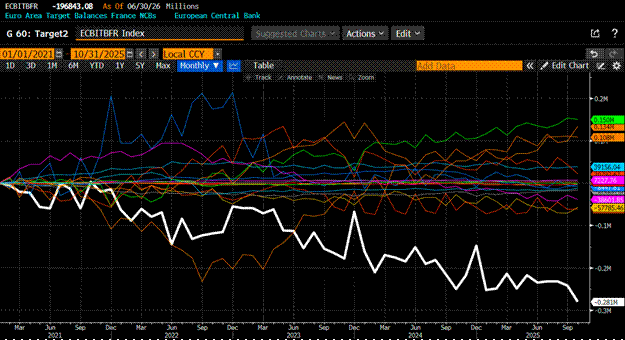
This is a chart of the change in Target2 balances from 2021 to the present. France (white) started as a net creditor, which means more Europeans moved euros into the French banking system than French savers withdrew to other European banks. But starting in 2021, that trend reversed and turned France into the biggest debtor in the Target2 system. This means that both French savers and other Europeans are pulling euros from French banks and placing them elsewhere in the Eurozone. Why are they doing this?
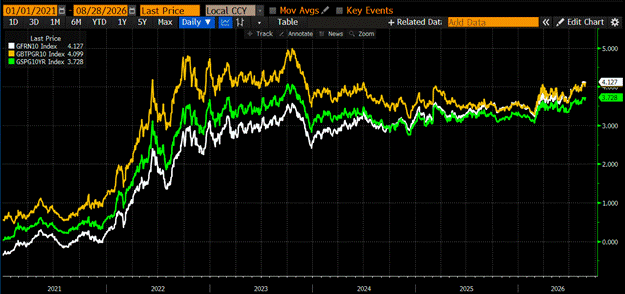
These are the 10-year bond yields of France (white), Spain (green), and Italy (gold). Spain and Italy are two of the largest and weakest Eurozone economies, and France went from the strongest to the weakest government bond market measured by 10-yields.
France borrows the most money because its government spending represents roughly 60% of the total economy; only Finland has a larger state presence. Therefore, France must borrow exponentially more every year to cover the ever-increasing deficits, which weighs on yields.
Unfortunately for France, it now relies more on foreign (mostly German and Japanese) hot-money to finance the rising deficits.

As bad as that is, the real question is politically: do the French people desire a larger or smaller government? Across the political spectrum, the French agree that the problem with France is that the government isn’t large enough. Remember that the nation ground to a standstill because of strikes protesting the coked-up teacher fucker President Macron’s proposal to lower the retirement age by a few years. In the 2027 presidential election, polling in second-place behind Marine Le Pen, the far-left presidential candidate Jean-Luc Mélenchon had these choice words for foreign creditors on August 25th, 2025, after a speech by French Finance Minister Bayrou:
Do not provoke a crisis by spreading an atmosphere of panic around France. The 3000 billion in debt is not ours. It belongs to foreign investors at 60%. Let them be cautious with the French. If they amuse themselves by trying to bankrupt France, they will pay the bill.
Now, do you blame European savers, including the French, for removing their capital from the firing line? Capital controls and financial repression will come to France because it is the only option to maintain government expenditures at the level the population desires.
Into this powder keg Bessent lit a match, and the fire will spread to its conclusion next year. Schrödinger’s euro will rise from the flames.
Japan–The Match
As I wrote about in my essay “Yen-Quake”, the BOJ refuses to raise rates. The bureaucrats in charge do not want their institution bearing the losses and blame for a yen that must strengthen. Therefore, the government will cajole the private and quasi-public sectors (aka Japan Inc.) to sell foreign assets and repatriate the capital, thus boosting the yen. The problem, as I outlined, is that the largest pool of assets owned by the Japanese are American. Pax Americana leaders will not allow one of the largest holders of its financial assets to dump them to solve their domestic problems. The threat is, and this is what South Korea is learning currently as Trump reduced the size of the military drills and rerouted the to-be delivered THAAD interceptor missiles to the Middle East, if you do not do what we (America) say, you can face China alone. In order not to step on historical cultural landmines, it is easier for Japan, South Korea, Taiwan, and most of North Asia to do what the ugly American says than relearn how to 说普通话.[3] I don’t believe there would be a hot war in North Asia without American military presence, but the fear and historical animosity are real and colors present day political and economic decisions.
The solution that Bessent offers is that instead of selling treasuries, Japan, South Korea, Taiwan, and other compliant Asian exporters that hold bigly sums of US assets, can swap them for dollars using the Fed’s FIMA repo facility.[4] Bessent and the Fed in the pursuance of American statecraft are ok with printing money to prevent a disorderly unwind of the post-1998 Asian financial crisis monetary system. I imagine Trump would even offer this to China if Xi would limit competition with America to certain traded goods. Unfortunately for Xi, exit from China’s mercantilist economic policy risks upsetting powerful, entrenched political interests, and therefore cannot be done.
European assets are the next largest pool of assets that Japan and other Asian exporters can sell. Bessent green lit selling Europe by selling euros (without checking in with the ECB first which is a breach of polite central banking protocol) to buy yen in the ESF during the most recent yen intervention. Trump provided the stick by showing what happens when Asian nations under the American security umbrella with proximity to China don’t follow orders. South Korea’s sin was refusing to participate meaningfully in Trump’s war with Iran. It will be interesting to observe Trump’s rhetoric and actions leading up to Xi’s US visit later this month.
While we don’t have definitive “this nation sold that, on this date”, we can look at the price of French bonds post the July 10th announcement by MOF head Katayama that Japan Inc. must repatriate capital.
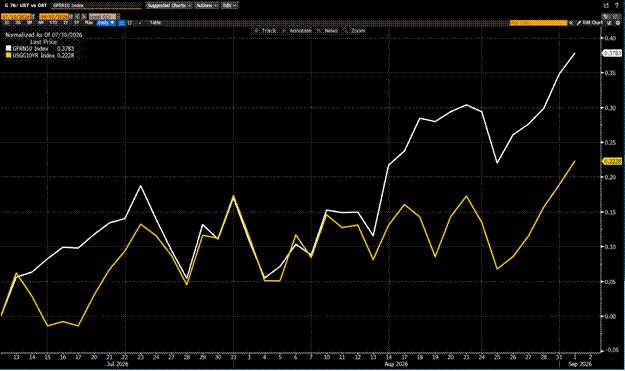
The 10-year OAT (white) yield rose 0.38% while the 10-year treasury rose by 0.22%. Japan Inc. got its instructions and turned from a marginal buyer to a seller of French government debt at the worst possible time.
Besides French government debt, foreigners hold ~71% of French bank debt. This will get sold as well.
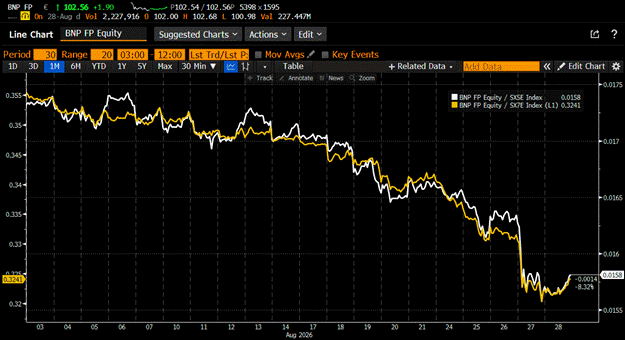
To illustrate the pain to come for French banks, gaze up upon this chart of BNP Paribas vs. Euro Stoxx (white) and Euro Stoxx Banks (gold). BNP is the largest French bank and is most importantly a GSIB that is a significant lender to US hedge funds; I will return to why this is important later.[5] August didn’t go well; BNP’s underperformance will only get worse from here as foreigners dump its debt, and depositors flee to Germany and Switzerland while they can. Panzer tank or bayonet, I know what I would choose …
It doesn’t have to be this way. The ECB created various money printing programs designed specifically to destroy free market pricing of European debt when its signals call into question the viability of the Euro project. But the ECB imposes a political test upon a national government before it will help it. In France’s case, do you agree that what happens in Brussels is more important than in Paris? If yes, then the ECB will print euros and buy what foreigners are selling. If not, then the ECB will sit quietly and allow the free market to operate.
The ECB prefers Macron’s successor to be a Brussels bootlicker as well, possibly even its current head, Christine Lagarde. Can you just imagine her slithering into the Élysée Palace? The French voters abhor that future. That is why they want either the left or the right, where both parties espouse a France-first mindset.
The ECB believes it can use fear to persuade the French voter to elect the “correct” candidate. By allowing the government bond and banking system of France to implode under the weight of marginal foreign selling, the ECB believes voters will choose more Europe over national sovereignty to make the pain go away. In 2011, the ECB ran this playbook perfectly in Greece. The Syriza party ran on a platform that, if implemented, would have pushed Greece out of the Euro, but the ECB scared the population so effectively that they voted for austerity and a non-consensual ass plumbing sans lube by then chairperson Super Mario Draghi. Given that the French youth struck across France to impoverish themselves for the benefit of the old, I don’t think the ECB can scare them into stupidly voting for austerity.
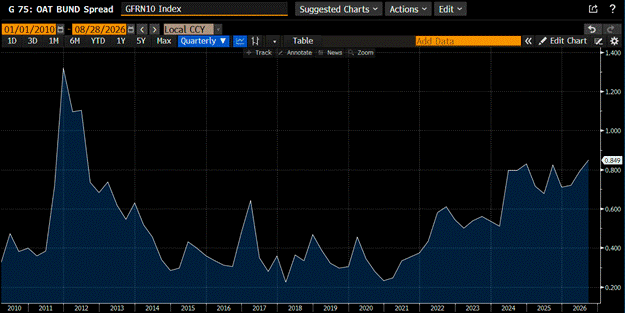
The more the ECB dithers in assisting France, the wider the spread between OATs and German Bunds, which is at the widest since the 2011 Euro crisis. Without the activation of the ECB’s TPI (Transmission Protection Instrument … you mean a condom … I’ll stick with Trojans) money printing scheme, OAT underperformance will continue.[6]
By May next year once France chooses its president, all the pieces come together and it goes KABLOOM!
Schrödinger’s Euro
How do you leave the euro without leaving the euro?
Even though the plebes say they want France, Germany, Italy etc. first policies, they are not ready to leave the euro. The ECB’s scare campaign and fake economics penetrated too deeply. Instead, the Banque de France will soft exit the euro by printing banking reserves to support the government and bank debt markets.
Let’s walk through how to both be in the euro and out of it simultaneously.
The problem:
Foreign selling of debt begets more selling, and government and bank bond yields rise.
The solution:
If the ECB won’t help, the Banque de France breaks rank and prints French bank reserves and conducts open market operations where it buys government and bank debt, placing it on its balance sheet. This is QE, and expressly forbidden by the ECB; it will become clear why it is verboten in a moment.[7]
Capital controls?
Capital controls are necessary. If capital leaves France, the QE solves nothing other than creating more offshore assets for unpatriotic savers. If capital cannot leave, the government will force its investment into “approved” financial assets, which in theory will increase French economic activity.
The euro effects:
France effectively devalued and created a livre-euro. It exists only inside France and is not convertible to other currencies unless the Banque de France allows it. It would operate like any controlled currency in that the government grants waivers to exporters to move money into and out of the system, conditioned on valid invoices.
The devaluation makes French goods more competitive vs. other euro members because the supply of livre-euros increases vs. the euro. Seeing France, the second largest Eurozone economy and most important member politically, devalue, every other member does it too … except Germany and a few Nordic states. As I stated earlier, most Eurozone member states’ economies cannot compete with Germany because they cannot devalue within the strictures of the euro. But in Schrödinger’s Euro they can, and will. That leaves Germany “following the rules” but effectively with the strongest currency in Europe … it’s the fucking Deutsche Mark all over again.
The Euro dies replaced by Schrödinger’s Euro, but that doesn’t tell us anything about dollar money printing. It explains why EURJPY falls, but to accomplish America’s exporting goals the dollar must weaken both vs. the euro and yen. I already talked about why the dollar will weaken vs. the yen in “Yen-quake”, now let’s touch on why Schrödinger’s Euro causes the Fed to expand its balance sheet to protect the treasury repo market.
How Do You Say “Repo” in French?
Fed chairperson Warsh the Weasel is a monetary hawk, right? At his recent Jackson Hole speech, Warsh reaffirmed the Fed would bring inflation, as defined by the government, not by plebes, under 2%. In previous speeches, he also said the Fed’s balance sheet was too large. To fully re-ignite the crypto bull market, we need an acceleration of the pace of Fed money printing. The Fed needs a reason to print money that it can plausibly deny, using unrealistic economic theories, that expanding its balance sheet to buy assets is not inflationary. The easiest place to look for future Fed money printing is where they are already doing it.
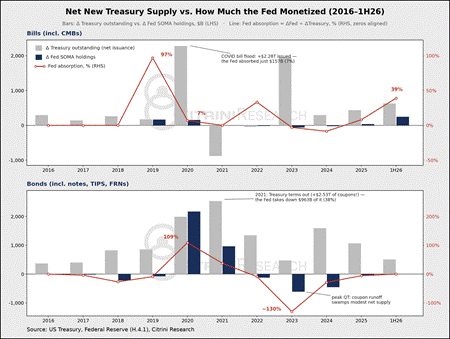
Currently, the Fed monetizes 39% of T-bill issuance, up from zero in late 2024. To repeat, the Fed prints dollars and finances almost half of Bessent’s short-end debt issuance. This RMP money printing caper began last December.[8] How can the market force the Fed to do MOAR!?
The Fed prints money via RMP to ensure that buyers of treasury debt who use repo can finance their cash treasury bonds at affordable rates. If repo trades at or below SOFR, all is good. When the rate trades above, it means there is insufficient liquidity in the system. After RMP began, repo predictably behaved.
What would cause the NY Fed to increase the amount of RMP T-bill purchases?
A reduction in repo lending by one or more large banks.
Are there banks in trouble that represent a large part of repo lending?
Yes, French GSIB banks led by BNP Paribas. I just discussed how their reliance on foreign purchases of their debt will materially impact their ability to function. BNP’s stock price underperformance is a harbinger of future credit stress and an increased pace of deposit outflows. The worsening of France’s Target2 deficit confirms this.
How much repo lending do French GSIB banks conduct?
According to the US Treasury’s OFR Money Market Fund Monitor, BNP Paribas, Credit Agricole, and Societe Generale collectively represent roughly 20% of repo lending. That’s fucking YUGE. If they reduce their lending, marginal repo rates will spike and create unpredictability in the rate of funding one’s bonds.
Unpredictability is the enemy of hedge fund relative value strategies. These funds use a fuck ton of borrowed capital to arbitrage minor price differences between various derivatives and cash treasury bonds. A hedge fund’s risk department will instruct portfolio managers to de-gross their books if they aren’t confident that they can fund at SOFR or less. If that happens, the largest marginal buyer of treasury debt reduces their purchases, which means Buffalo Bill Bessent pays more to roll his short-term paper. This cannot be allowed, and thus the NY Fed will dramatically increase the RMP purchases to cover the shortfall caused by the exit of French banks from the repo market.
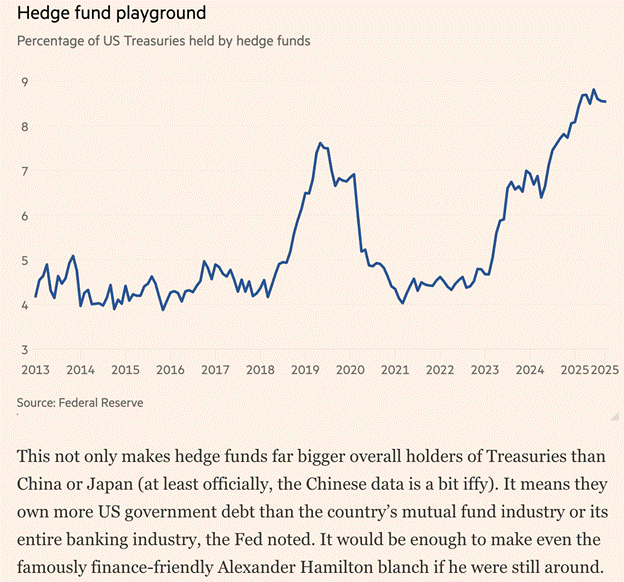
Reread that paragraph under the chart. There is no fucking way, José, that Warsh the Weasel is shrinking the balance sheet. You can ignore everything he says because the largest holder of treasury debt requires RMP purchases to continue funding the government.
How much Brrrr do we get?
That question depends on the pace of Bessent’s treasury buy-back program and use of the TGA to buy long-end bonds.[9] If Bessent up sizes his long-end purchases because yields refuse to fall, the Fed’s balance sheet expansion could quicken to close to $100 billion per month. The average monthly increase since December 2026 is ~$22 billion.
This quote from Buffalo Bill Bessent is direct evidence of his murderous intent upon those who do not heed orders:
People have bad information. I have asymmetric information. So, I think that the market should think: ‘Why would we have joined the Japanese in the intervention at this time? Do we know something the market doesn’t know … in terms of being willing to do … what I would call a Treasury twist here, in terms of the bond market? What do I know that the market doesn’t know?
Mother fucker sounds like a crypto degen cooing about how he painted the chart on some pump and dump shitcoin. He might not, thankfully, get any crypto regulatory bills passed, but Trump is surely the first crypto degen president, as shown by the rhetoric of his lieutenants.
Bessent wouldn’t be so cocky if he didn’t know fosho that the Fed stood ready to increase the pace of its current RMP money printing to stand behind the repo markets. Therefore, I don’t pay attention to anything Warsh says. If you listen to him, you deserve to be poor.
The best thing about the RMP setup is that it creates liquidity in the near term. The equity of French banks began selling off last month. As investors put the pieces together and the French election date approaches, the credit of these banks will get smoked; the ECB will gleefully cheer on the pain assuming it will torpedo the left or right’s chances at winning the upcoming presidential election. And when things are about to kick off, EURJPY will slump. That is why it is the only number that is a leading indicator of a short-term increase in the pace of dollar liquidity creation.
V-Day
Effectuating Schrödinger’s Euro is Bessent’s goal. He doesn’t need any country to exit the euro, just act in their own interest by conducting QE to pump their flagging bond markets. The result is an isolated Germany, replete with the strongest currency on the continent.
Into this euro shitshow, Bessent and Lutnick pick the nations off one by one. Bilateral trade deals for a little of this for that super charge American exports, which are now very cheap as the dollar weakens. The dollar dumps because its supply pumps because of Fed RMP purchases and loans (euro related) via the FIMA repo facility (yen related). Euro-yen degen!
Yachtzee bitches.
Trading Tactics
Obviously, if you can, buy EURJPY puts. We are trying to source some listed options, but it ain’t easy and is illiquid. Thankfully, even if I can’t put on an outright position, I have exposure to cheap EURJPY vol through my stake in David Dredge’s Convex Asia vol fund. If you have an ISDA with a bank, go nuts, but as I have learned, when you trade OTC derivatives with investment banks, it’s a big door in, and a small door out.
As crypto degens, we possess the fastest horse to capitalize on Bessent’s grand, intentional or not, plan. Money will get printed for two reasons. First, as I described in “Yen-quake”, when the Fed removes the cap on per counterparty usage, the FIMA repo facility will allow the Fed to print dollars in the trillions and allow American allied nations to obtain fiat liquidity without dumping their treasuries. The largest user will be Japan, which is why the yen will strengthen. Second, which is the main topic of this essay, the implosion of French banks and the departure from repo lending will necessitate the Fed’s increased use of the RMP facility, thus printing money and expanding its balance sheet to fund the US government’s spending. Let the EURJPY be your advanced smoke alarm that French banks are about to go kaput and the Fed will print to ensure the well-functioning of the treasury market.
Maelstrom’s preferred cryptos haven’t changed. Our structural Bitcoin long will anchor the portfolio. The more speculative short-term end of 2026 bets are still Ether ($10k price target), Ethena ($0.5 price target), and Ether.fi ($2 price target). Where is my Zcash? Idk I think the AI stole it from the orchard pool.
Follow instructions, mother fuckers. Bessent ain’t fucking around. See y’all, after a hard day shredding wet Patagonian pow, it’s time to put some dollars on my skin…
Want More? Follow the Author on Instagram, LinkedIn and X
Access the Korean language version here: Naver
Subscribe to see the latest Events: Calendar
[1] ECB - European Central Bank
[2] ESF - Exchange Stabilization Fund
[3] English: speak Chinese
[4] FIMA - Foreign and International Monetary Authorities
[5] GSIB - Global Systemically Important Bank, basically too big to fail.
[6] TPI - Transmission Protection Instrument
[7] QE - Quantitative Easing
[8] RMP - Reserve Management Purchases, to learn more about exactly how this program functions, please read “Love Language”.
[9] TGA - Treasury General Account
I see the 4-year Bitcoin cycles here, and we’re already heading toward new highs.
"Yachtzee bitches." ~ Bill (Buffalo) Bessent to Christine Lagard at the G20 Summit on Dec 14