

(Any views expressed here are the personal views of the author and should not form the basis for making investment decisions, nor be construed as a recommendation or advice to engage in investment transactions.)
Want More? Follow the Author on Instagram, LinkedIn and X
Access the Korean language version here: Naver
Subscribe to see the latest Events: Calendar
Did you hear that? The AI bros suddenly developed a conscience and are worried about humanity’s survival in the face of their almost silicon-God’s ascendance. It’s been almost silicon-God for some time now, but suddenly it’s almost almost silicon-God and therefore it’s time for introspection as to the path forward for the development of AGI.[1] That’s the narrative, but cynical me looked at the calendar and thought, it’s almost the close of the third quarter and Anthropic hasn’t IPO’d yet. I wonder how those financials look? Is that hockey stick growth of annualized revenue they allude to in press release after press release slowing down? They decree they are profitable if they remove all business running costs. I can’t wait to parse through to be released their S-1 and understand exactly how much it costs for them to serve a token to a customer. And while they are being so honest with everyone, just exactly how many customers are profitable, and is that cohort increasing or decreasing? But alas, I will not get answers to my questions because “Safety First”.
As readers can tell from my tone, I believe that Anthropic, OpenAI, and SpaceX’s pronouncement that Safety First guides them to slow down development of AGI is not driven by any concern for the wellbeing of unenlightened humans, but by the economic reality that the market doesn’t want enough of the AI they are selling at its current price. To be specific, the market loves AI, but at the China price, which is 1/100th as expensive.
When the China Price hits an entitled US AI bro, they first cry, “But that Chinese shit is of terrible quality”. As the Chinese quality quickly closes the gap, they wail, “But the Chinese distilled my model to make theirs.” The market doesn’t care why the Chinese model is 1/100th the price; it just wants the cheapest form of intelligence. Then the AI bro sobs, “well we care about humanity’s safety, so we have paused development.” Isn’t that sweet … but the football World Cup level performance of faux injury comes when the AI bro demands, “that it is still worthy to beat China so it is time for the government to step in, create regulations, and continue funding the race for AGI.”
The reason the “Safety First” excuse for a cessation of AGI development by the three leading US AI labs is important for financial markets and global fiat liquidity is that these labs’ demand for compute backs over $1 trillion of investment grade and hundreds of billions of lower credit quality debt and loans.
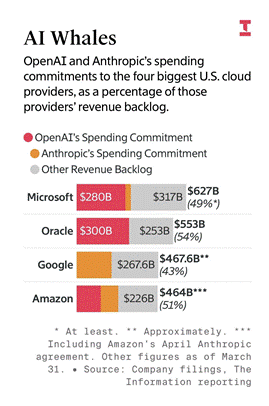
The AI labs combined do not generate ANY profits. Therefore, they require the support of profitable tech companies like Nvidia, Broadcom, Google, Microsoft, etc. to provide an off-balance sheet backstop of the debt issued to sign leases with data centers and purchase semiconductor chips. These future purchases of chips and hardware depend on the AI labs buying it to train the latest and greatest, almost almost almost silicon-God, and processing inference requests for their customers. But if Safety First is the new guiding mantra, then spending on training new models will not stop but certainly fall from the current heights, and they will focus on driving greater efficiency at converting electricity into intelligence, which means customers spend less on compute. Safety First is by definition compute demand destruction.
If cash flows financed AI CAPEX, then there would be nothing to fret. But the trillions of dollars of debt remain, whether the AI labs buy the compute. While defaults won’t happen for some time, the price of said debt should decline with the unwillingness of the AI labs to consume compute as per prior assumptions. The real question is who bought the debt, and did they do it using leverage? Obviously they did degen. It wouldn’t be a capitalist utopia if a finance bro didn’t lever up and buy dogshit debt. Who is the ultimate bag holder?
Millions of American insurance policy holders are implicitly long the AI story, and Safety First non-consensually ass fucks them sans lube. I didn’t fully appreciate the scam, but Nick Nameth of Mispriced Assets laid it out real clear, and I will attempt to simplify it for my small brain degen crypto readers. The conclusion is that a large swath of the US insurance industry is insolvent if AI debt is properly marked to market, and that presents the question that is at the heart of investing in a global economy run by fractionalized banking, “Will the US government do one of the following: become the compute buyer of last resort in the name of national security, or print money to bail out underwater insurance companies?”
Either way, we as Bitcoin holders and crypto investors win. If the government disregards the market signal that building the almost almost almost almost silicon-God isn’t profitable, then it will print money to fund an unproductive economic good which invariably will lead to higher financial speculation and Bitcoin prices. If the government bails out the insurance sector, it prints money to cover non-performing AI debt, which will increase the money supply and subsequently the price of Bitcoin.
The rest of this essay will step through the mechanics.
In the name of Choyna
In the name of national security, the government can justify anything. Just look at the destruction wrought by the US government because they scared the plebes into believing a global war on a method of war would save them from the brown bedraggled Bedouin bandits after the 9/11 attacks in New York City. This time around, the bogeyman is a slanty eyed Chinaman who studies real hard; does that funky maths shit; and steals “amazing” US technology to sell it back to them at 1/100th the price … because of the Ricardian comparative advantage, duh. To beat Choyna, state socialism within a capitalist system is required.
The AI bros successfully red pilled Trump and his lieutenants to such a degree, that they ignore both the private market signals that AI is unprofitable and the voters who across the political spectrum do not want more data centers built and demand compensation for the theft of their data. If Choyna offers an affordable AI product, the counter is to outspend them on the creation of the almost almost almost almost almost silicon-God (I’m going to keep adding almost’s because we are so close to AGI it just requires more faith, theft, and taxpayer support).
Because the future of everything (war, economics, robotics, etc.) is downstream of AGI, then the rest of the world must consume AGI at America’s pleasure. In this way, because America is the most tolerant and fair culture on the planet, it cannot allow this silicon-God to be controlled by apostate, read non-Judeo Christian, societies like China. Eye roll, eye roll, eye fucking roll. I have personal preferences for where I live, but others have theirs. Even if I believe my version of a moral culture isn’t what’s offered in certain countries, I am not willing to bankrupt myself or die forcing that vision upon the world. You can believe America or Western culture is superior, but don’t hand Elon, Sam, and Dario trillions of your tax dollars. Supposedly America is superior because it believes, most times, hundreds of millions of informed citizens come together in free markets to decide the price of goods and services. The government gets out of the way and lets these market derived signals decide what gets produced and in what quantities. But now, because of national security, based on the assumption that spending trillions can produce that AGI by ingesting data to predict the next token, the signals the market produced are incorrect. Instead, the US government must ensure that it spends even more to create the next frontier model so that its culture can dominate China’s. That is hubris, and we know what happened to Icarus when he flew too close to the sun.
Get the fuck off your soap box Arthur, and talk to us about the bailout.
Safety First means less demand for compute from the big three US AI labs. In steps the government, using offtake agreements to ensure AI labs earn a guaranteed profit, similar to what they offer to certain defense and mining companies. The government will use this compute to further the research and development of AGI. Finally, the government could lease back its models to the labs to allow them to sell inference to Americans or other consumers from allied nations at astronomical prices.
This approach ensures that the government owns the frontier models and allows the rest of the Western world to use them at its pleasure. The problem with the private AI lab model is that these labs are global companies, and sometimes their pursuit of profitability by selling access to anyone globally conflicts with the national security concerns of the government. If Chinese labs partly advance by distilling the more advanced models from US labs, then by controlling the development directly, the US government can easily keep China a few months or years behind in the race to AGI. Even if this were true, it would fail in the same way that attempting to keep advanced semiconductor manufacturing processes and equipment from China failed to smother their ability to produce cutting-edge chips. Information wants to be free, and with the existence of the internet, it is impossible to restrict its flow. In the pre-internet era, the US couldn’t even prevent the Soviet Union from obtaining information on the atomic bomb right after its successful creation. Anyone who thinks it will be different with AGI doesn’t understand human nature and ingenuity when the stakes are this high from a nation state perspective.
Funding the almost silicon-God requires issuing more debt. That is an easy sell given that the monetary mandarins, US Treasury Secretary Buffalo Bill Bessent and Fed chairperson Warsh the Weasel, believe that AI is productivity enhancing. They are certain that the US can grow its way out of the debt pile by wholeheartedly adopting AI, and they are not wrong. June 2026 US nominal YoY GDP was 6.6% vs. an effective fed funds rate of ~3.6%. Given that Bessent continues to increase T-bill issuance, the government profits 3% on the debt issued, but savers lose. If the government deficit is 3% or less (a big if), then debt-to-GDP declines. Growth is primarily driven by the AI data center build out, upheld by AI labs’ compute demand. Therefore, from a financing perspective, it is profitable for the government to become the compute buyer of last resort if it continues to allow a 3% profit on any dollar of short-term debt issued.
There is no free lunch. The government doesn’t run a surplus but a deficit, and must borrow to spend. That wouldn’t be an issue if Warsh the Weasel played ball, but his Fed, to date, isn’t singing from the same hymn sheet as Bessent’s Treasury department.
The price of money just increased for the first time since July 2023; the Fed voted unanimously to raise its policy rate by 0.25% at last week’s meeting. The quantity of money created by the Fed is not growing. RMP purchases of T-bills stopped on August 14th.
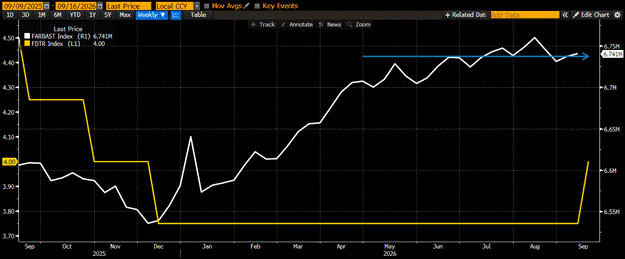
If the government pursues this strategy without the Fed lowering the cost of money and increasing its quantity, the increase in debt issuance will cause rates to rise. This will only inflame voter anger at all things “AI” as their mortgage, credit card, and car loan rates will increase. If Trump and Bessent don’t get at least seven members of the FOMC back onside, the feasibility of this strategy diminishes.
What I just said would be the conventional view of the current Fed’s policy and would lead to bearishness. However, remember that there is another powerful money printing engine: commercial banks. Warsh and Bessent both espoused the view that the banking sector should take over operation of the Brrrr button. Since August 14th, when the RMP purchases stopped, the banking sector picked up the slack by creating over a hundred billion dollars of money by growing its total asset base. This is consistent with the relaxation of regulatory liquidity restraints.
Besides growing its asset base, because of the recent 0.25% Fed rate hike, banks will now receive an additional $7.5 billion per year in interest on their excess reserves parked at the Fed. This money will be used to increase loans and financial market speculation. Therefore, the conventional view that the Fed hiking rates and ceasing balance sheet expansion needs to include the effects on the commercial banking system as well. And when you combine the two together, the net effect is stimulative. Therefore, if the government so chooses, the liquidity situation will accommodate additional borrowing to splooge on AI compute.
However, if the government doesn’t buy the compute, then debt impairment will occur. Those who own the debt on leverage are in trouble. Let’s dig into the captive insurance scam.
Captive Insurance
I want to thank Nick Nameth on Substack for this insurance scam education; please read his article “The Hole”.
The insurance industry is something I never studied. Therefore, the trend by large PE masters of the universe to fund their investments with captive insurers’ assets didn’t seem scammy to me. But as I dug into the mechanics, I discovered the location of the sucker.[2]
In every credit bubble, there is a sucker. Usually, it is a pool of retail investors managed by highly credentialed fiduciaries. The fiduciaries invest other people’s money and get paid twice: by charging management fees, and by selling investments to retail they own themselves, thus pumping their bags. Here, the suckers are buyers of life insurance and annuity products from US national insurers. To fully understand the scam, we must talk about why the golden era of PE ended, and what the PE bros did to keep the party going.
PE bros take an existing cash flow, apply debt, extract a dividend, and finally leave the company carcass to rot in the private market. When the public markets become frothy, they re-list this dogshit company and complete a circle of life. This is rational behavior when in the aftermath of the 2008 GFC, the private sector deleveraged, and the Fed dropped interest rates to zero.[3] Therefore, it made little sense to take risks and expand production to service broke ass plebes who were just trying to make monthly payments on a house with negative equity they couldn’t afford. PE investors, who could borrow at almost zero, looked for cash flow positive companies with low to no debt. They weren’t interested in producing a better product in higher quantities (their customers can’t increase consumption); they want to maintain cash flows where they are, cut costs, and load on debt. In this way, they can extract a cash dividend to pay their investors.
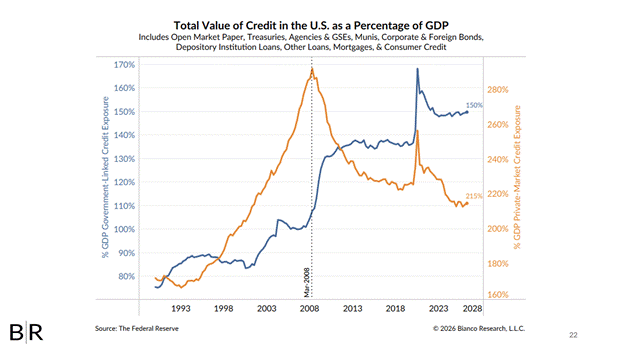
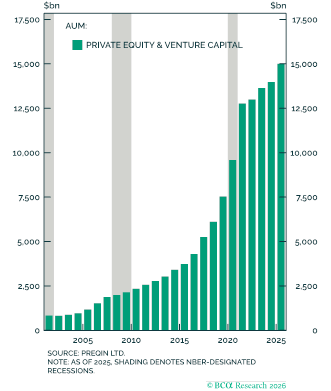
The law of diminishing returns hit PE fund returns hard at the same time the cost of capital started rising post-COVID. Because of cheap financing, winning a deal required paying a higher multiple for a stream of cash flows. As a result, PE fund returns fell. To raise the next fund, PE bros searched for a less discriminating pool of capital that didn’t want their money back. Enter the insurance company. An insurance company offers life and annuity products where policyholders pay premiums, and the insurer invests these sums to earn a return. The insurer will pay out at a later date, most times decades from when they initially sold the policy. This is the perfect pool of evergreen capital to invest in PE funds choked full of overpriced private companies and high yielding private credit. The PE bros purchased the insurance company, installed themselves as the investment manager, and then stuffed their dogshit down the throats of unwitting policyholders. This is called captive insurance.
The next leg of the trade, where it gets super scammy, is how the captive insurer funds the capital buffer the law requires it to hold against its assets. Financial assets sometimes fall, and thus insurance regulators require insurance companies to hold a certain amount of capital buffer against the assets for policy payouts. The insurance industry created reinsurers, or companies that exist primarily to take the risk of repayment off large insurance companies. Usually, insurers and reinsurers are not affiliated, and thus the reinsurer prices the risk at market. But that wouldn’t work for the PE insurance scam because the whole point was to find a sucker to buy assets without the PE fund putting material skin in the game. Therefore, the PE insurance company created a captive reinsurer directly affiliated with its parent. The captive insurer affiliate required little equity from the parent for its reinsurance policy.
These are all regulated entities, with periodic public disclosures. Would you purchase a policy from an insurance company you knew ran a scheme like this? To hide the scam, the American capitalistic system went to bat for the PE bros. In certain states, like Vermont, the law runs counter to prudent national standards. The insurer and its affiliated reinsurer can create a reinsurance risk sharing asset, secretly, with as much or little capital buffer as they desire. The state regulator blesses the bastard and then places it under seal.
There is more, but before I continue explaining this brazen caper, let me contextualize this by creating a crypto hypothetical. Remember Terra Luna … Luna failed because USDT holders dumped the stablecoin and broke the dollar peg. What if Do Kwon had the juice of a septuagenarian New York PE bro, how would the situation have played out differently?
As the USDT price falls, Luna purchases an insurance company called Alameda Insurance; Luna will use the capital inflow to pump USDT in the market and hopefully restore the peg. Alameda sold life insurance policies to Californians and thus possesses a multi-billion dollar capital base. Alameda can’t buy a shitcoin stablecoin, but it can buy investment grade debt. Luna bribed a few Moody’s analysts so that they would bless its corporate debt as investment grade. To entice investors like Alameda, Luna paid 5% over the 10-year treasury yield in 2022. Wah out performance! Alameda incorporated a reinsurance company called Three Daggers in Vermont. Alameda pledged $1 of equity for every $100 of reinsured assets. Now Alameda told its regulators that the $10 billion of investment grade Luna debt it purchased with policyholder premiums was money good because if something went wrong Three Daggers would pay out. All good. But USDT continued dropping in price, the $LUNA shitcoin continued dumping, and a few weeks later Luna missed a coupon payment. Even though the Moody’s analysts got Daytona Rolexes as payment to lie about Luna’s creditworthiness, they couldn’t ignore a missed coupon and downgraded the debt to junk.
The downgrade triggers the downfall of this structure. Regulated insurers cannot avoid putting up more capital after downgrades. The problem is that the reinsurance asset was always bullshit. Three Daggers doesn’t have hundreds of millions of dollars of cash to send up to its parent so that the parent can satisfy the higher capital requirements. The jig is up; Alameda’s books now reflect its insolvency, and the regulators must clean up the mess.
What happens to policyholders? They get fucked. In most states, the maximum guaranteed payout is $250,000 to $300,000, but what if your policy should have paid out millions? Soz. Even more fucked up is that the surviving insurance companies pay for the guarantee. No firm paid into a guarantee fund before the credit event, which differs from how banking insurance works in the US. The FDIC requires banks to pay insurance premiums before an event.[4] Because surviving insurance firms pay into the guarantee fund after the fact, it encourages maximum risk taking by all parties because they never pay for their own bailout.
Let’s bring it back to TradFi. Replace the shitcoin project’s debt with private credit extended to software companies getting crunched by the proliferation of AI and purchases of AI data center debt whose value depends on the big three labs purchasing compute.
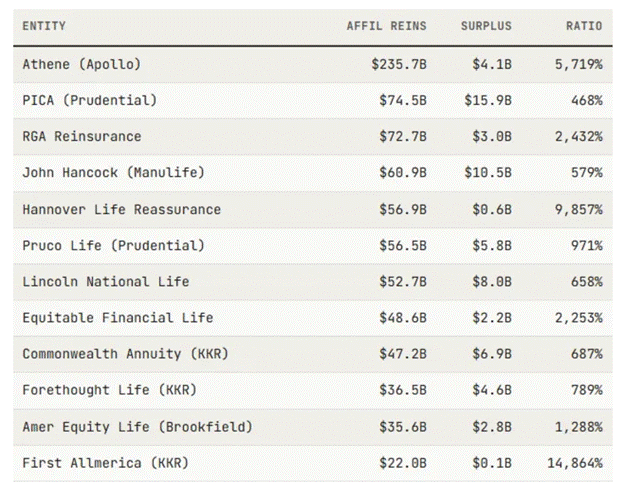
The “Affil Reins” column is the made-up capital backstop that supposedly covers the investments in all things AI by the PE masters of the universe like Apollo, KKR, and Brookfield. We don’t know the asset quality on the captive insurer’s books, as they deliberately domicile in states and jurisdictions where they can hide their true financials. But if we read the press releases, in every major AI data center debt issuance, one of these large PE firms is present. We also know that these firms were the largest private credit funds that invested in SaaS companies. These private credit funds are already preventing investors from withdrawing money because they cannot liquidate these illiquid loans fast enough at high enough prices.
Nick Nemeth believes the bullshit captive reinsurance asset totals $1.54 trillion. How much of this is real we don’t know, but he provides an illustrative example of a Brookfield reinsurance asset that was found to be booked at $1.48 billion valuation, but the entity that provided said insurance told the regulator it was on the hook to pay ZERO.
The private credit and AI debt markets are creaking under the large amount of issued debt. Before everyone knows that everyone knows that PE captive insurers are insolvent, we get glimpses that the façade is cracking. The trigger will be downgrades of investment grade AI data center securitized debt issues. These insurers purchased the highest rated tranches at high yields relative to similar duration treasuries. If the big labs do not consume compute in the amounts needed to create cash flows to payoff data center debt, eventually the ratings agencies will downgrade the debt, triggering the parent insurer to come up with cash it cannot source from the affiliated reinsurer. For us whose portfolios need an increase in money printing to profit, the potential multi-trillion dollar hole in the balance sheets of insurance companies is ripe for a bailout. The boomer policyholders vote, and they will vote themselves a bailout. In 2008, when AIG became known as the sucker of last resort to hoover up shitty CDO Squared debt, the government bailed them out. Remember that TARP capital plugged AIG’s hole, and this money went straight to Goldman Sachs, who paid record bonuses in 2009.[5] The plebes got a foreclosure slip, and the patricians got a phat cheque. America Fuck Yeah!
It’s going to happen again, but this time, Bessent and Warsh aren’t stupid enough to flirt with the idea of capitalism. Paulson and Bernanke tried to hold the line that if you lost money, you went out of business as a financial services firm.[6] They allowed Lehman to fail, which was a mistake, and focused the public’s attention on how the finance industry fleeced them. This time, Bessent and Warsh will not allow one of these large insurers to go bust and create the substrate for a 2028 Big Short-esque theatrical release. They will continue to print money to make sure that reckoning never happens because maybe this time around the plebes and their populist political champion won’t be so malleable. Obama, a supposed progressive Democrat, won in 2008 partly because of the recession and rhetoric that the bankers wouldn’t escape punishment for creating the crisis. However, when it came time to make good on his campaign promises, he approved the bailouts and did not use his electoral victory to halt foreclosures. AOC in 2028 won’t be so nice; so, Warsh and Bessent better not give her the chance by making sure there never is an observable credit event.
If Trump decides not to become the compute buyer of last resort, ratings agencies will downgrade AI data center debt, and then the printed money will come in drips and drabs to prevent a market realization of the insolvency of the insurance industry.
More of the Same
Safety First doesn’t herald a massive up swell in printed money immediately. It gives Trump a choice, we as Bitcoin and crypto investors, don’t care what he decides because both roads lead to more money printing. This essay should give one confidence that the choppy nature of the crypto markets post the late August mini-pump will end soon. The amount of dollars in the system will continue to grow, and Bitcoin and selected shitcoins will rise in in price.
As a founder of an AI / crypto project, the Flop Network, that requires cheap compute, this setup is glorious. The raw cost of compute will fall because the US government will not allow the free market to stop building AI data centers. This will create a glut of spot compute, increasing the use of AI agents. In addition, the surge in printed dollars will cause investors to chase cryptos as a financial asset that performs the best as the supply of money grows.
Yachtzee oh my Yachztee bitches!
Want More? Follow the Author on Instagram, LinkedIn and X
Access the Korean language version here: Naver
Subscribe to see the latest Events: Calendar
[1] AGI - Artificial General Intelligence
[2] PE - Private Equity
[3] 2008 GFC - Global Financial Crisis
[4] FDIC - Federal Deposit Insurance Corporation
[5] TARP - Troubled Asset Relief Program this was one of the primary bailout vehicles in the US Subprime Mortgage Crisis
[6] Hank Paulson - US Treasury Secretary; Ben Bernanke - Fed Chairperson
Hilarious romp through one thin slice of the logical debacle that is western civilization! Bravo!
"the U. S. government will not allow the free market to stop building AI data centers"
Kind of an oxymoron. The almost almost almost almost free market.