
Situationship


(Any views expressed here are the personal views of the author and should not form the basis for making investment decisions, nor be construed as a recommendation or advice to engage in investment transactions.)
Want More? Follow the Author on Instagram, LinkedIn and X
Access the Korean language version here: Naver
Subscribe to see the latest Events: Calendar
Let your gaze wander and feast your beady eyes upon the disfigurement of Earth’s natural environment visited upon it by humanity. Some alterations are pleasant and some horrific, but each one started as an idea in one or more evolved primates’ conscious brains. Given the cacophony of stimuli our brains must process, we use internal stories to create coherence. In this way, the story or narrative creates its own reality.
Deducing the collective delusions of market participants becomes paramount when divining the future ebbs and flows of prices. Depending on the story, investors will pay a greater or lesser multiple for the same nominal future stream of cash flows. The easiest way to “re-rate” a staid and boring business is to change the narrative to match what investors currently froth at the mouth to acquire at any price.
The question of internal framing is the key variable that determines whether AI is a bubble. But before we understand the bubbliciousness of AI, the better question to ask is in what kind of businesses are we investing, or in relationship terms, “What are we”? The dichotomy, at least to my Luddite brain, is the distinction between what investors believe AI CAPEX represents: is it technology or real estate? The zeitgeist is that this multi-trillion dollar build out is “technology” and must receive insane growth multiples by the market. But I believe AI CAPEX is just another boring real estate play. However, in this instance, what’s inside the data center is compute that creates silicon-based lifeforms that will aid human civilizational development in the most profound way since the railroads.
The distinction between real estate and compute is important because the recently post-pubescent hedge fund bro, the bank, the private credit fund, and ultimately the government believes funding the building of a data center and power plant is like lending to Apple, instead of lending to Lehman Brothers. The bursting of the AI bubble will occur because financial intermediaries, tacitly supported by the US and Chinese governments, will over build data centers and everything that goes into providing the substrate to house chips that train AI models and conduct inference. Therefore, the AI bubble is a credit story like 2008 and not an earnings story like 2000.[1]
In 2000 the typical internet bubblicious IPO earned little to no revenue and certainly not a profit, a la Pets.com, which is a dearth of earnings story. In 2008, US house price appreciation decelerated, which caused solvency concerns for banks and other financial institutions that underwrote mortgage debt, which is a credit bust story. The AI bubble bursts when the growth of data center construction or the hyperscaler forward guidance on the amount of data center construction decelerates. Leading AI companies will continue to earn massive profits, but the forward multiples will contract and cause solvency issues for the weakest AI credits. This stresses the balance sheets of the highest leveraged financial players that hold too much AI-related debt. Ultimately, the government will step up in the name of “national security” to ensure over-leveraged AI companies and their financiers survive. And this misallocation of capital will find its way into crypto … pumping Bitcoin to da moon!
For any AI bull, the common retort to the assertion that “AI is a bubble” is Jovan’s Paradox will justify the massive spend. Jovan observed that as the price of a commodity falls, its usage increases such that the aggregate revenue continues to grow, and exponentially so. If your internal dialogue about AI is that CAPEX is synonymous with the demand for compute, then Jovan’s Paradox means there is nothing to worry about. As the cost of compute falls, the demand for AI token-consuming solutions and agents grows exponentially, therefore lending to AI CAPEX is money good. But this is an incorrect intellectual framing of Jovan’s Paradox regarding the current AI investment landscape.
To understand why Jovan’s paradox doesn’t mean all credit siphoned away to AI CAPEX is money good, let’s go through what a hyperscaler does when they build a data center. A hyperscaler engages in a real estate development project to build a container for which they purchase the newest semiconductor chips to train AI models and conduct inference. Given that over time, with any industrial process, especially for semiconductors, the number of floating-point-operations per kilowatt-hour of electricity increases exponentially. Therefore, in a few years’ time, Nvidia, AMD, Intel, Huawei, SMIC, etc. will create chips that are exponentially more efficient at producing intelligence. The current stock of physical infrastructure that houses these server racks could produce 1,000x more intelligence and consume less electricity. That means that both things can be true: we can saturate the market for the physical build-out of AI data centers, and consume exponentially more AI tokens. Do you really want to be in the real estate business, which is what the hyperscalers are in, or do you want to own the AI application layer?
The next retort from the AI bulls is that the hyperscalers are both landlord and tenant. They use their prodigious cash flow generated from web2.0 attention theft businesses to underwrite the debt issued to build data centers, and then use the intelligence they own to sell AI Edenic apples to humanity. If you believe that is the case, I hope you don’t own the debt. Debt is called fixed income for a reason: the best you can get is par plus some interest. If Google moons because they correctly allocated capital to building out gangster AI products that change the course of human civilizational development, hip hip hooray for equity holders, but debt donkeys only get par. But if Google is a depreciated Nvidia chip slumlord unable to earn revenue sufficient to meet debt and interest payments, debt holders take a bath, and an above-zero recovery value for a data center choked full of obsolete silicon chips is suspect. The hyperscaler CFOs and finance bros aren’t fools; they know they are in the real estate business and thus must find a sucker who believes they are investing in tech and not property. Those suckers are captive insurance companies owned by the likes of Apollo, and US and Chinese citizens who ultimately are on the hook for the implied government backstop of AI credit. If you parse through the deliberately unintelligible financial statements, you will discover the debt issued to fund AI CAPEX all sits off balance sheet with no clear connection to the earnings powerhouse that underpins the equity.
The logic behind the internal story we tell ourselves about AI CAPEX is important because it informs us why capital will be misallocated and why the magnitude will be bigger than the railroads. And because the AI bubble is a credit, not earnings, story, we know the government MUST bail out the ultimate sucker who bought old-school property debt thinking it was newfangled technology EQUITY!
Don’t let the recent AI correction, especially in over-leveraged markets like Korea, spook you. The AI bull market is not over. If anything, it will enter the blow-off top phase soon. The Fed had the opportunity last week to attack persistently above-trend inflation as measured by every single fugazi measure available by raising rates. But they held rates steady instead, and even former chairperson Powell voted in favor. For us forgotten about crypto degens languishing in the doldrums of a sideways bear market, why does the trajectory from good to bad credit allocation vis-à-vis AI matter? It matters because it informs the how, why, and how much of the mostly American, and a sprinkling of Chinese, money printing to stave off a financial crisis because of the misallocation of credit to AI CAPEX build out.
The rest of this essay will discuss this theory and why the government must respond with printed money. As credit expands against a deceleration of AI CAPEX spend, Bitcoin will bottom and begin a secular rise. Once the authorities sufficiently panic because their AI-created GDP growth is just another run-of-the-mill property bubble, they will print money in sums greater than the 2008 GFC. This will ultimately drive Bitcoin to one million and beyond.
The Second Derivative Rules the Roost
I consistently must remind myself that investing is all about trading the second derivative; i.e. acceleration and deceleration. This makes intuitive sense because during periods of accelerating growth, we tell ourselves stories about an asset that point to a boundless future. It inspires statements like “I would rather [hyperscaler name] go bankrupt than miss out on a chance at building AGI”[2]. But at some point, growth decelerates. The problem for investors is that asset prices usually peak during the acceleration phase, go sideways during the deceleration phase, and only start falling when growth (or velocity, the first derivative) turns negative. We can never know for certain how long it takes between decelerating growth and an outright contraction of velocity. But so many investors, myself included, believe that an asset can go up forever even after acceleration turns to deceleration. If the AI bubble is a credit story, the second derivative is extremely important because society lends to build AI CAPEX assuming a constant acceleration of spend growth. When that falters, adding more debt becomes precarious. But as a society, we don’t know when to stop until a financial crisis punches us in the face or Kenny G buys our portfolio at the lows. Therefore, credit issuance continues to grow during the deceleration phase. Only when AI CAPAX schedules actually contract do we get the Wiley E. Coyote moment and markets begin to suss out the players who are over leveraged because of their holdings of dogshit AI CAPEX debt.
Let’s extend this logic to how the US subprime mortgage crisis played out. One of my favorite courses during university was on US housing policy and effects on the mortgage market, taught by the undersecretary of housing during the Clinton administration. I took the course in the spring of 2008 when Bear Stearns went poof like Jimmy Cayne’s joint, so it was very à propos. The key message about the housing crisis was that lending surged after government policy encouraged everyone to own a home in the name of social justice even if by 2006 many first-time homeowners couldn’t afford the to-be-reset monthly payment unless house price growth continued accelerating. Don’t worry, I’m still waiting for my 40 acres and a mule, so let’s print some money and build houses instead ;).
Below is a four-panel chart depicting the S&P 500 Index, construction loans/activity, and the Case-Shiller US national housing prices.
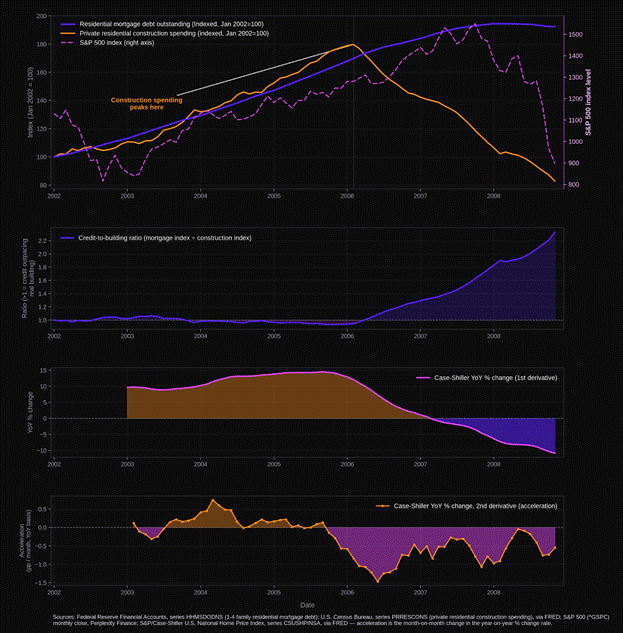
Home price appreciation decelerated by the end of 2005, which marked the peak in real spending on construction (orange line, top panel). However, credit continued to flow to real estate (purple line, top panel) until the stock market peaked and corrected slightly. Between 2006 and 2007 was the no-man’s-land period where house price growth decelerated. Predictably, the stock market peaked in mid-20027 (dotted magenta line, top panel). The Wiley E. Coyote moment started in August 2007 when the three BNP Paribas credit hedge funds went bust and slowly progressed as it took Bear Stearns and Lehman down by September 2008. By that point, the S&P 500 was already off 50% from the high. And then the financial collapse happened when investors discovered who held all the toxic financial Frankenstein derivatives. It took the government buying the debt and the equity of those afflicted to stop a great depression; this is key to remember when we come to how the government will save the AI bros.
The second panel is interesting because it shows the beginning of the misallocation of capital starts right as house price appreciation decelerates. If issued credit goes towards building more houses, then that’s okay. But when the system must issue more debt to pay down past debt, which a rising ratio of construction loans to construction spending illustrates, that is the seed of a credit collapse.
Let’s extend the same analysis to the AI story. The variable in this case is the announced CAPEX spend. Right now, the market believes that real estate is technology, and more technology equals more profit. Therefore, the market rewards a hyperscaler who announces a rising CAPEX budget by ramping the stock.
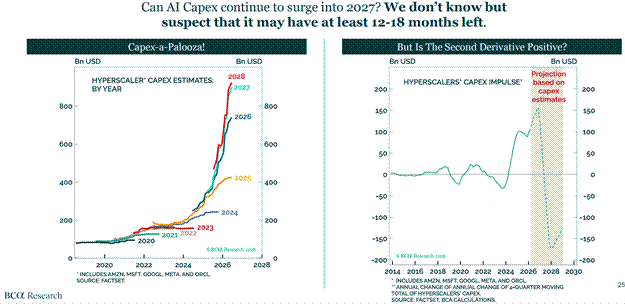
The announced pace of CAPEX build out will begin decelerating in mid-to-late 2027, and it will become very apparent by 2028 the deceleration phase is upon us.
While announced CAPEX growth decelerates, the amount of credit provided will increase. Because lenders believe they lend to technology ventures rather than real estate, and the US and Chinese governments proclaim they each must “own” AI for the world, it makes sense to lend and only lend to anything related to AI CAPEX. In 2027 the market enters no-man’s-land, similar to 2006 to 2007. The current AI stock dump is a corrective episode within a bullish trend. Next year we will experience the true AI bubble peak, and then the market will reward hyperscalers who defect by decreasing CAPEX budgets.
Unlike in the beginning of the bubble from 2022 to mid-2026, hyperscalers increasingly must fund AI CAPEX not out of free cash flow but by issuing debt and equity. The potential harm to their balance sheet will prompt more introspection whether building real estate to house more depreciating chips makes economic sense. At least for the US hyperscalers, the low-priced but comparable quality Chinese frontier AI models will pour cold water on their delusions of their silicon godhead. Everyone chooses the cheaper version if the quality is just as good or slightly worse. That is China’s bet, and it worked for EV cars, solar panels, batteries, etc; it will work for AI as well. As the per kilowatt-hour intelligence output of a silicon chip exponentially increases alongside an inverse reduction in price per token because of Choyna, a prudent hyperscaler CFO will not degrade their balance sheet further by borrowing to build more real estate. And even if demand for tokens ramps aggressively because of Jovan’s Paradox, it won’t happen quick enough to counteract the negative convexity for the stock of debt issued a few years prior. The market will punish the weakest credit, revealing the gargantuan waste of capital.
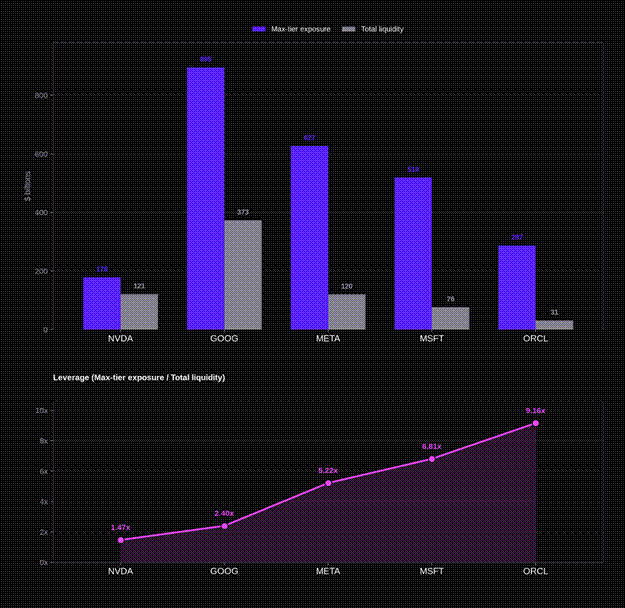
I cannot predict which hyperscaler will go too far and cause an “oh shit” moment amongst debt donkey investors. But before I move on to why banks cannot help but lend to AI even when they intuitively know it’s no bueno, take a gander at the below chart, which depicts the announced commitments by hyperscalers versus their cash on balance sheet. Trillions of dollars of leverage powers the AI bull narrative, and one of these companies will flame out just like wunderkind Leopold Aschenbrenner, but it will be Warsh and Buffalo Bill Bessent bailing them out with the printing press instead of a rapacious east coast neuro spicy hedge fund bro.
Loan Officer Dilemma
The AI CAPEX growth declaration is an oft-mentioned reason the AI bubble is close to extinction. But if that is the case, why would banks continue to lend? They will do so first because it is profitable, second because the government tells them to, and finally because they know if their loan book sours a bailout will rescue them.
Louis-Vincent Gave at Gavekal Research wrote an interesting article last week arguing that Warsh is running a simple strategy regarding his interest rate policy. That is to engineer a steeper yield curve so that bank lending becomes more profitable. It also helps inflate away America’s massive debt pile. Ultimately, banks will lend money into existence, which funds the re-industrialization of America and funds AI development. This policy is consistent with the Hamiltonian economics Buffalo Bill Bessent referred to in recent speeches.
By all objective measures, the Fed should have raised rates at its last meeting. But they didn’t and the back-end of the yield curve revolted.
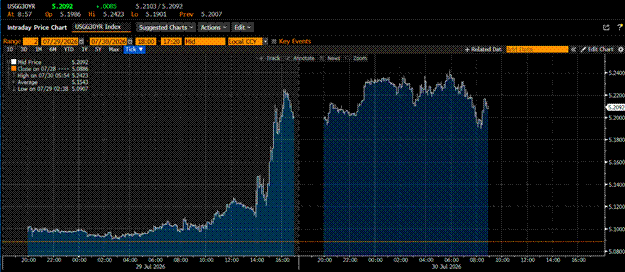
30-year treasury yields spiked after the Fed held instead of hiked.
Some say this is a Fed policy error. But from the vantage point of a bank, it’s a godsend. Banks borrow effectively at Fed Funds, which the board deliberately holds below nominal economic growth or at a negative real rate. And then banks lend long to AI data center real estate developers, or rare earths miners, or weapons producers, etc. The banks’ profit increases the steeper the yield curve, and as the below chart of commercial and industrial loans illustrates, lend more money into existence.
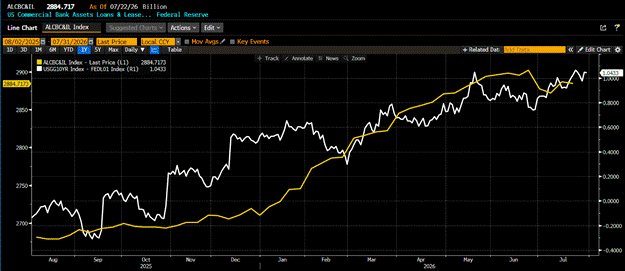
10-year yield minus effective fed funds rate (white) which shows the yield curve steepening vs. US commercial bank total commercial and industrial loans (yellow)
Politically, this is a durable Fed policy because even voting governors (Cook and Powell) who Trump’s DOJ indicted/investigated, voted in favor of keeping short-term rates negative. Warsh possesses a coalition of the willing composed of Trump toadies and TDS survivors. Monetary policy-wise, the Fed’s recent actions allow Bessent to issue treasury bills at a yield below that of nominal economic growth. If the market cannot handle the gargantuan weekly bills auctions, the RMP program prints money to plug the difference.[3] To lower the naughty high and rising long-end bond yields, Bessent can conduct buy backs where he issues T-bills that the Fed monetizes, and buys ten or thirty-year treasuries to cap yields. Notice how Warsh, the supposed balance sheet hawk, has done nothing to curtail or cease the Fed’s balance sheet growth via the RMP program. It’s all kabuki UFC on the White House lawn theatre.
For a loan officer at a TBTF bank who wishes for career progression, they will approve loans to critical industries like AI and bomb makers.[4] It makes the bank more money and aligns with Fed and Treasury policy. And if it goes tits up, which mathematically is likely, the bailout will be swift and bazooka-sized. There is no downside, and that is how “Window Guidance” operates in the land of the free, home of the IRGC - Israeli Reactionary Guard Corps.
The Treasury-Fed Accord of 2026 occurred without an explicit announcement. But what else can you name a situation where the Fed keeps real rates negative, prints money to buy T-bills the Treasury issues, and the Treasury encourages bank lending to critical industries by protecting the downside with implicit bailouts to be provided by the political party in charge. I’m fucking bulled up, but wait there is even more printed money coming.
The American Sovern Wealth Fund
I want to really feel the crypto bullishness in my veins, so follow me through a speculative idea on how the US government could do more than just bail out the banks at the first hint of trouble. Mental masturbation is always fun.
The bailout of AI already started under Trump. In the name of national security and winning the AI race against China, the US government borrowed money and purchased equity stakes in businesses that operate in “critical” industries like rare earths mining and semiconductors. This is dollar liquidity positive or equity QE because inert dollars move from the government’s checking account into the financial markets.[5] Below is a list of deals where the government purchased an equity stake using previously borrowed money under the CARES Act, CHIPS Act, and Department of Defense budgets:
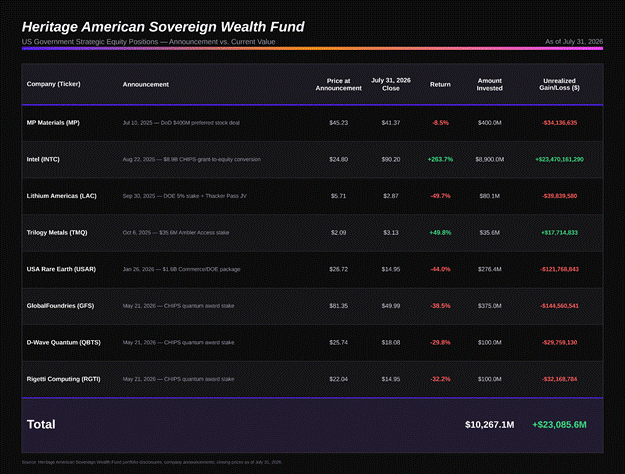
Unfortunately for us crypto degens whose wealth ebbs and flows with the amount of printed money injected into the system, there is minimal headroom remaining under existing legislation to conduct similar equity purchases. But the willingness shown by the Trump administration and US Treasury Secretary Buffalo Bill Bessent to punt stonks with borrowed money means that if they could, they would not hesitate to purchase stakes in the stonks of AI companies on the down and out. Because in their minds, if Pax Americana does not dominate AI, Pax Sinica will instead. So out with pure capitalism, and in with corporate socialism. Soz if you are part of the 90% of American plebes that own no stonks better vote for AOC in 2028.
The question then becomes: is there a way pre-crisis to print money and buy AI stocks for national security? Yes ser, and the best part is it requires no congressional approval to do so.
Under the Federal Reserve Act, during “emergency and exigent” circumstances, the Fed can print dollars and lend freely to US Treasury-created SPVs.[6] During the 2008 GFC and 2020 COVID hoax, the Treasury funded a first loss equity tranche using funds from the ESF of an SPV the Fed lent to in order to buy financial assets to prop up the system.[7] Currently, the ESF has $28 billion with which Bessent could direct towards funding a new SPV to support AI companies for national security reasons. In previous instances, the Fed provided up to 10x leverage to the SPV structure, which means Bessent could splooge $280 billion on money-losing AI ventures. That’s nice, but it is hardly a bazooka given the fugazi multi-trillion dollar market caps these private and public AI companies possess. To marshal more printed money firepower, could Bessent create an SPV with no first-loss equity buffer? Technically yes, but the Fed must stand up to political pressure that it is creating backdoor unlimited equity QE.
Does the Fed care about political pressure? Yes and no. Supposedly, newly appointed chairperson Warsh is ready to shake up the Fed. He routinely touts the productivity-enhancing miracle that AI could soon be for the American economy. Therefore, intellectually, he believes the AI bro sophistry. If his daddy Trump tells him it is necessary to save Sam Altman and OpenAI by purchasing stock in the open market because there are insufficient retail schmucks ready to part with their hard-earned cash and buy an unprofitable frontier AI company when Dario’s Anthropic is both profitable and produces the most intelligent models, then Warsh is ready to ride or die. But in order to approve the loan to the SPV, he requires three more members of the board of governors to agree. Given that TDS survivors Cook and Powell voted with Warsh in favor of holding rates steady at the last meeting, I don’t see any pushback if Warsh pushed the Fed down this path. Profiting from stock holdings in your personal account always trumps supposed intellectual hangups about printing money. 加油美国![8]
If the Treasury uses printed money to support the new issues of to be listed AI darlings, it monetizes the unrealized profit of early investors and employees. This is the purest definition of liquidity creation because this capital didn’t exist before the government provided a bid underneath non-sensical private market valuations. The government benefits in two ways from an accounting perspective. First, investors will pour capital into any government-backed AI company because it is always profitable to invest alongside the entity using printed money to pump bags … at least initially. The SPV now sports a massive unrealized gain which Trump can tout as profit that in theory should count against the national deficit. If AI is the most consequential technology in human history, the stock market paper gains could retire the entire national deficit on an accounting basis. Second, newly minted millionaires, billionaires, and trillionaires must pay state and federal capital gains taxes on the stock they sell to the market. Again, this reduces the national deficit and allows the government to borrow less money and claim on an accounting basis that the debt-to-GDP ratio fell. At least initially, the bond market will rally (yields fall) and reward the government for this paper shuffling.
I must clarify that Trump has not created the philosopher’s stone, but kicked the can down the road to the next, hopefully for his supporters, Team Red Republican administration. To illustrate why this ends in disaster in the medium term, let’s consider the following scenario. Imagine you want to become a billionaire overnight doing no work. You create a company for a few thousand dollars in setup fees with 1,000,000,001 shares. Then you sell 1 share to your mother for $1. Based on the last traded price of $1, your one billion shares are worth one billion dollars, at least on paper. Now, to convert this paper into real wealth, you go to the bank and ask for a $100 million loan to buy a new McMansion, a Lambo, and various other high-value items. The banker says no fucking way. You shockingly inquire why, because in your mind, the loan-to-value ratio is extremely low at 10%. The banker responds that there is no liquidity for this stock should you need to sell to repay the loan.
Moving back to the AI SPV equity investments, if the SPV is one of the largest single shareholders, and other investors only invested because the government is involved, then it follows there will be no buyers when the government wants to sell. In fact, everyone will rush to sell alongside or before the government once the teleprompter dude, Ro Khanna, Nancy Pelosi et al. sell. That paper gain used to offset national debt in accounting terms vanishes completely and turns into a realized loss that is added onto the debt pile, and to add insult to injury, the treasury still must pay back the Fed in the future. Ultimately, it is a one-way investment for the SPV; it can never sell, and the Fed must roll over its loan so that there is never a margin call. In this way, the expansion of the Fed’s balance sheet to fund the SPV becomes permanent. But this isn’t Trump’s problem because he gets to have his political cake and eat it too. Unprofitable American AI companies can battle against China. The AI “wealth” created funds tax payments and spending in the economy right now. And the unrealized gains plus the tax revenue creates a chimera that debt-to-GDP is falling, which prompts the market to allow the government to borrow at cheaper levels.
The government could do this now and forestall an AI reckoning, or wait for the market to punish all things AI first because of a deceleration of AI CAPEX spending growth and then an outright contraction in CAPEX spending. Given that the US government already purchases equity stakes, why not do MOAR! Combining bank lending Window Guidance with AI equity purchases ensures a credit crisis never happens … at least not until after the next US presidential election in 2028.
That’s great Arthur, but how does this help Bitcoin if the money printing from 2022 to now hasn’t pumped Bitcoin above $126,000? Be patient, young Padawan, and read on.
The Bitcoin Bottom
When will Bitcoin hit a local bottom? The previous cycle’s bottom occurred after the market discovered the theft of FTX customer money by the right kind of white boy Sam Bankman-Fried; Binance CEO CZ, a shifty Chinamen (this is probably the pejorative descriptor used by the minds of Kevin O’ Leary or the author Michael Lewis) aided and abetted said discovery. ChatGPT commercially launched, and the AI boom began.
Starting in October 2023, the US liquidity situation changed in that the amount of dollar liquidity began rising because of the drainage of the RRP.[9] Subsequently, bank lending and government borrowing increased as well. Bitcoin pumped and peaked in October 2025. But Bitcoin couldn’t rise further; it climbed only 2x over the previous all-time-high, because AI credit and equity sucked up the marginal unit of fiat. As the acceleration of AI CAPEX build out consumed all available fiat liquidity, and Bitcoin, predictably obvious only after the fact, fell by 50%.
In mid-2026, the liquidity situation flipped. The growth in announced AI CAPEX spend 18-months out will decelerate, but the bank and government lending channels are only getting started creating dollars to hand to AI. And when or if the banks fail to do their patriotic duty, the government will heavily nudge them to provide the credit. Failing that, the government will provide equity backstops to favored AI companies and offtake agreements, like with Intel and IBM, in order to de-risk bank lending to AI. Bitcoin will bottom during this initial period of credit misallocation. But the financialization of AI, whereby there are more dollars and yuan chasing money good AI projects than exist, will create capital misallocation. This is exactly the scenario that played out in the Chinese property boom from the mid-1990s to 2019.
Chinese planners decreed that urbanization must proceed at the most rapid pace of any society in human history. That required a multi-trillion dollar infrastructure build out of dwellings, airports, roads, railway lines, etc. For many decades, state-directed bank lending to this build out was productive. But in the late 2000s, society reached saturation of profitable projects, and subsequently, the period of capital wastage began. By 2019, President Xi had enough and proclaimed, “房子是用来住的,不是用来炒的 (apartments are for living in, not speculation)” and he deliberately popped the bubble and redirected credit towards manufacturing new technologies like EVs. But the period from the late 2000s to 2019 witnessed massive speculation on financial assets with borrowed capital ostensibly provided to build property. That is why property companies became hedge funds. A similar phenomenon will occur in the US. An outfit with the right politically and financially connected board members will procure cheap credit and possibly a government equity investment supposedly to do something related to AI, but will create a business model that is leveraged to the price of some input, e.g. a pseudo-AI hedge fund. Bitcoin is the liquidity smoke alarm, and its rising price will reflect this capital wastage alongside surging AI stock prices.
Writing this essay in late July 2026, I don’t know at what price Bitcoin will bottom; maybe it already did. The market needs time to climb the wall of worry surrounding Bitcoin sales by Strategy. And it needs to find a narrative why the asset can rise if Strategy cannot issue more stock or find suckers to buy its preferreds and use the proceeds to buy Bitcoin. Maybe Bitcoin chops between $60,000 to $70,000 for a while with a potential downside of $50,000. However, while all of this occurs the AI capital wastage accelerates, which lays the foundation for a bottoming and slow grind higher for Bitcoin.
The Bitcoin Crack-Up Boom
If my thesis is correct that the dollar-value of money-good AI CAPEX projects is less than the amount of credit issued to “AI”, then Bitcoin’s price will reflect this excess liquidity. This helps Bitcoin bottom even though DATs like Strategy can no longer tap the equity and corporate debt markets to buy Bitcoin in a Bitcoin-per-share accretive manner.[10] I continuously validate the thesis by observing whether AI CAPEX growth decelerates while AI lending increases and or hyperscalers increase off-balance sheet commitments.
If we enter the capital wastage phase of this AI credit boom, then the next question is what will the authorities do? Will they preemptively print, or if they lack the political juice, wait for the eventual crisis to ram through another bailout. Thankfully, by being long Bitcoin unlevered we don’t care when the bailout cometh because we know, because of the perverse incentives of the government, they will always print to save the system. The AI CAPEX credit bonanza is already on par with the build out of the railroads as a percentage of GDP, which means the amount of capital misallocation is already larger than US subprime, therefore the bailout will be bigger than the trillions printed by the Fed and every other major central bank in the aftermath from 2009 to 2013. Bitcoin emerged as a response to the irresponsible bailout of the subprime banksters, which, when you think about it, is an amazing feat. This time around, Bitcoin already exists and can now fulfil the dreams of many by hitting $1 million or higher.
To imagine this future, given the current bombed-out nature of the crypto capital markets, is difficult. Which, to me, presents interesting asymmetries. Maelstrom is already long a fuck ton of Bitcoin, so what’s the next new shitcoin narrative that can pump a large cap coin within the next six months? Ethereum is the most hated and forgotten about mega-cap shitcoin out there. It has not traded through its 2021 all-time high of $5,000, while most of the top 10 shitcoins by market cap have. The new narrative to me is that corporate RWA chains like Robinhood will use customizable Ethereum layer-twos like Arbitrum.[11] Ethereum becomes the security settlement layer of these chains. So even though the actual percentage of gas fees that actually accrue to Ethereum is small as a percentage of the total, Ether is the shitcoin that powers the tokenization of everything.
I am an RWA hater. Maelstrom receives a lot of garbage pitches about how a team is going to ride the tokenization wave. That being said, TradFi loves to wax lyrical about how everything will be tokenized and ride on some private or public blockchain. I fervently believe that if this future comes to pass, these TradFi RWA plays must ride on a public blockchain. And Robinhood launching its own chain using Arbitrum removes the career risk from TradFi muppets running the same playbook and ultimately building their solution using Ethereum. This narrative fucks. And because Ether, as a shitcoin, is the second largest by market cap and has existed since 2015, it has the second-best Lindy behind Bitcoin. Add to that, Tom Lee at Bitmine provides the institutional cover for portfolio managers to ape into Ether to play the tokenization of capital markets meta.
My rough target price for Ether by the end of 2026 is $5,000, which is ~2.6x up from current levels. I like this trade because I can strap on a significant amount of notional to this trade and feel comfortable with the risk of waking up one morning and Ether being down 75% because of some technical exploit is negligible. It is also extremely liquid, so even though as a percentage of Maelstrom’s portfolio it will be a large trade, I can get out of the position in minutes. Finally, I will also sell out of the money puts to earn extra yield and be comfortable with the risk that Ether trades through my strike and I have to buy it at bargain prices.
The AI bubble stole liquidity from crypto, but no longer. As the narrative slowly shifts from “AI at any cost” to “what’s my return ON investment?” and finally to “when is my return OF investment?”, the authorities in Pax Americana and Pax Sinicia who staked their entire economic policy on “AI” will worry that maybe just maybe the bubble could crack, and to forestall this eventuality so that they do not have to admit their mistakes, will misallocate capital on a scale necessary to create a crypto bull market like we haven’t seen since 2021.
Want More? Follow the Author on Instagram, LinkedIn and X
Access the Korean language version here: Naver
Subscribe to see the latest Events: Calendar
[1] Thank you to Groundbreaker for an excellent Substack post which provided the inspiration for this thesis.
[2] AGI - Artificial General Intelligence aka God
[3] RMP - Reserve Management Purchases
[4] Too Big to Fail
[5] QE - Quantitative Easing; The Treasury General Account (TGA) is the government’s checking account held at the Federal Reserve.
[6] SPV - Special Purpose Vehicle
[7] ESF - Exchange Stabilization Fund
[8] Let’s Go America
[9] Reverse Repo Program
[10] DAT - Digital Asset Treasury
[11] RWA - Real World Asset
Always some of the best info/analysis/direction by anyone out there. Thanks, Brother, your views are always appreciated!
Most important phrase = “the application layer” LfG