
No Trade Zone


(Any views expressed here are the personal views of the author and should not form the basis for making investment decisions, nor be construed as a recommendation or advice to engage in investment transactions.)
Want More? Follow the Author on Instagram, LinkedIn and X
Access the Korean language version here: Naver
Subscribe to see the latest Events: Calendar
Because Maelstrom’s trading went quiet in the first quarter, many of our brokers occasionally ping me asking my thoughts on the market and if there is anything they can do for us. I reply, “It’s a no-trade zone”. Apart from slowly increasing our long position in Hyperliquid, we did fuck all trading in the first quarter. Two developments combined to produce a trading dead zone, at least for our long-only positioning. The proliferation of agentic AI’s or claws, will destroy the career prospects of the average knowledge worker in flexible-labor advanced western economies (mainly Pax Americana), which will cause a deflationary financial collapse. I wrote about this in my essay, “This Is Fine”. Since the publication of that essay, to turn Iran into the latest Trashcanistan, Emperor/Entertainer in Chief US President Donald J. Trump launched a war of choice against Iran with support from his belligerent bedraggled backup singer Israeli Prime Minister Benjamin “The Bedouin Butcher” Netanyahu. Almost seven weeks into the war and the only question that matters are what arrangements will prevail regarding commodity and goods flows through the Strait of Hormuz.
I always preface my opinions on war or geopolitics with the statement that I am a simple ski bum and house music two-steppin’, crypto bro. I don’t know shit about war fighting or have any insider knowledge about what global leaders will or won’t do. But I can read the dominant propaganda narratives and employ my AI agents to conduct simple maths using publicly available information. I try to abstract away the noise and focus on what is important for my portfolio. Thankfully, I don’t live in the Levant or the Middle East; therefore, my life and liberty aren’t at risk.
In my simplistic worldview, there are three scenarios to consider; actually, there are four, but the fourth; nuclear Armageddon is un-investable and therefore there is no point writing about it. I will present each, and then dive into, at a high level, how they could affect the price of Bitcoin. I do not know how probable each situation is. But what I want to understand is whether there is a portfolio construction that outperforms in the best case the price of hydrocarbons and their first derivatives like food and fuel prices absolutely, and in the worst case underperforms the price of hydrocarbons but outperforms relative to every major asset class.
Scenario One: Back to Normal
In this scenario, the war ends immediately, and the pre-war status quo returns. However, the secular trend to replace expensive digital symbol-manipulating knowledge workers with cheaper and more efficient AI agents continues unabated. The American economy is the most exposed because its GDP is ~70% driven by consumer spending. Consumers finance their materialism using bank credit, and these loans become assets on banks’ balance sheets. Should the ability to service debt by the average knowledge worker evaporate, these banks will become functionally insolvent, requiring a large dose of central wanker banker printed money.
Scenario Two: The Tehran Toll Booth
In this scenario, the US military is unwilling or unable to stop Iran from restricting the flow of ships through the Strait of Hormuz. Iran makes good on its promise to allow “friendly” ships to transit the Strait by paying a $2 million toll in Chinese yuan, crypto, sanctioned dollars, or other diplomatic arrangements. In the worst case for Pax Americana’s financial hegemony, nations must now come up with yuan. Given that most countries run a trade deficit with China, the only way to raise yuan in significant size is to sell dollar assets (e.g. US Treasuries and or US big tech stonks), buy physical gold, and sell the gold via the Shanghai or Hong Kong gold markets for yuan. Of the top ten largest economies by GDP, only Brazil and Russia run a trade surplus against China, and these are the ninth and tenth largest economies.[1] In contrast, Pax Americana runs the largest trade deficit of any economy, which is financed by an equally gargantuan capital account surplus. However, as countries sell down their dollar assets to raise yuan and or cover commodity shortfalls in the spot market at egregiously high prices, the empire’s capital surplus must mathematically fall. The financialized American economy requires foreign capital to finance its government spending; without it, the maths don’t add up. Eventually falling bond prices or rising yields, and falling equity prices will require an injection of printed dollars to fund the government.
Scenario Two Point Five: The Star-Spangled Blockade
In an interesting turn of events, after the failure of the American and Iranian negotiators to come to a deal that would cement a permanent ceasefire, on Sunday, April 12th, Trump announced the US Navy would block all ships entering or leaving the strait. Maybe this blockade will develop into the Robber Baron Toll, where ships must tithe twice followed by chanting Allu Akbar and Halleluiah to the Iranian and American wise guys. Or maybe there are so many ex-post exemptions issued to this or that nation that the blockade is merely a piece of moldy swiss cheese. The point above still stands, if holding dollars cannot guarantee pirates won’t tank your shit, why hold them at all?
Scenario Three: The Empire Strikes Back
In this scenario, the US Airforce & Navy do what they are supposed to do and destroy the ability for the IRGC to interdict shipping in the Strait of Hormuz via a punitive stand-off bombing campaign.[2] The Strait re-opens and any ship can safely transit for no additional fee. The restoration of the supremacy of the mighty empire removes the need for countries to use any other currency except the dollar, nor bid for expensive commodities in the spot market, at least for a few days. The problem is that ending Iranian control of the strait most likely means the complete destruction of the country. Or, as Trump puts it, “sending them back to the Stone age”. Many blood thirsty Americans who grew up from birth being fed propaganda that Iran is the most evil country on earth, cheer this macho posture towards enemy numero uno. However, destroying Iran in this fashion means in Iran’s last gasp, they will make good on the promise to take the rest of the Gulf region’s commodity and energy production to the grave with it. The spice definitely won’t flow and global central banks will have no choice but to print money into a general commodity spike to save the global financial system.
If you live in certain shithole countries, the domestic currency will hyper-inflate against the dollar or ruble. America and Russia will be the only large swing producers left who can fill the gap left by a smoldering Middle East. There will be famine and general social unrest. So, while your Bitcoin might be worth infinite units of some toilet paper fiat currency, your wellbeing is at serious risk if you cannot flee in time.
Before I move on to how Bitcoin fares in each scenario, let’s quickly step through some chart porn to provide pictorial evidence to corroborate my prose.
Scenario Chart Porn
Back to Normal
Given that I wrote about this scenario at length in my essay “This Is Fine” let me repost some charts and tables I provided in that essay:
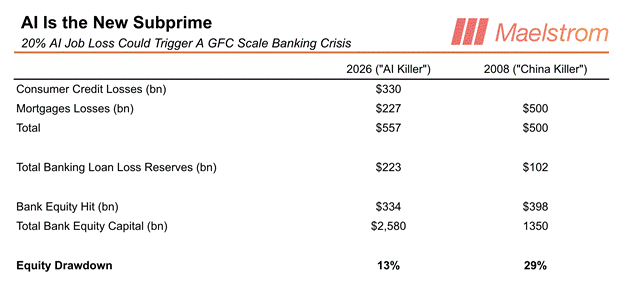
In summary, the AI agentic deflationary bust is up there in severity with the 2008 US subprime mortgage crisis.
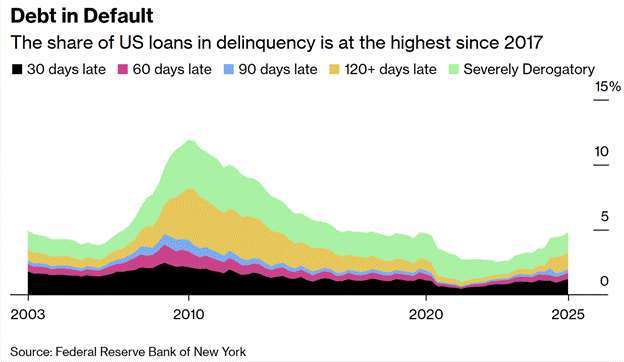
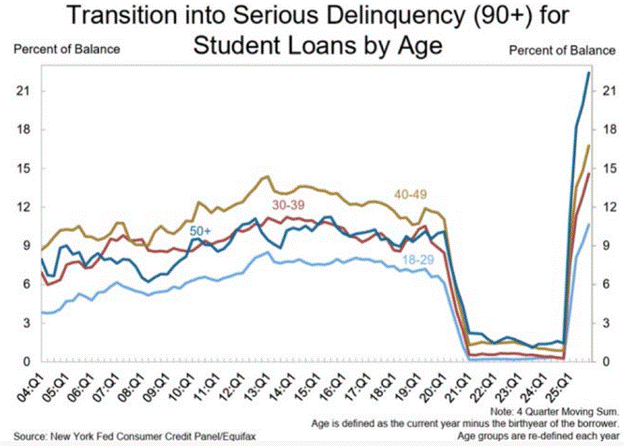
Consumer credit delinquencies are already rising, and the pink slip party hasn’t even started in earnest yet.
The Tehran Toll Booth
Essentially, if this scenario occurs, it is the end of the petrodollar and the rise of a new global reserve currency or a basket of them. Currently, the IRGC is very flexible on payment terms. But if they cement their power over the strait, why would they continue to accept a toll in dollars given that the US is doing everything it can to restrict their ability to spend them? Ultimately, I believe they will not allow payment in dollars. The yuan and gold will most likely become the two primary currencies of sovereign trade.
Why would any nation save in dollars if they cannot ship goods without paying a toll in yuan obtained by purchasing gold? Given that most major economies run trade deficits with China, the only way to raise yuan is to sell dollars, buy gold, and then purchase yuan. From now on, nations must save trade surpluses in gold, not US treasuries or equities.
To highlight how the yuan’s use in trade is growing, I want to focus on a few charts posted by Luke Gromen that show how a pseudo yuan-gold standard is quietly emerging.
Step 1: Sell dollar assets (treasuries) and buy gold
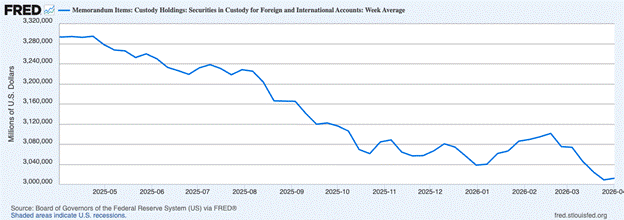
Since the war began, on a net basis, foreign securities holdings with the Fed fell $63 billion. I’m using this as a proxy for the directionality of foreign holdings of treasuries and other dollar securities like stocks.
What did sellers do with these dollars?
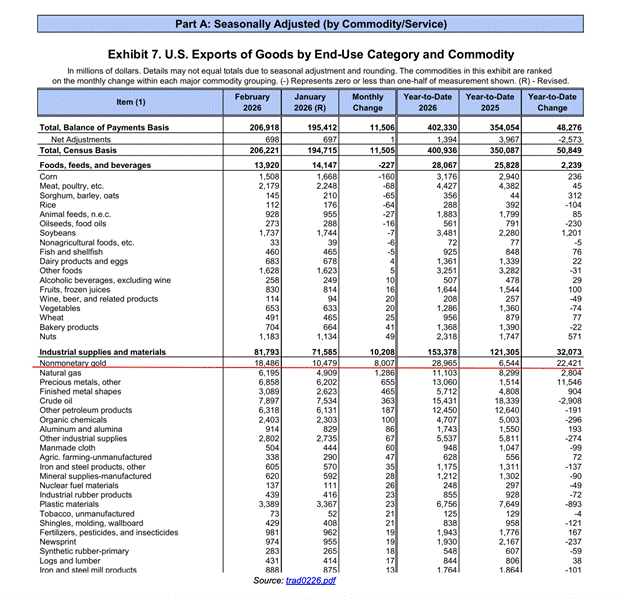
Non-monetary gold is the biggest US export for the fourth month out of the last 5 months, up 342% YoY.
They used these dollars to buy gold and ship it out of America. So much for the resurgence of American manufacturing; the only thing leaving America is a barbaric relic. Soz to all the Trump supporters who thought they would get their highly paid factory jobs back. Yet another US Presidential cycle resulted in blue-collar workers receiving a non-consensual ass-fucking sans lube.
Step 2: Sell gold for yuan
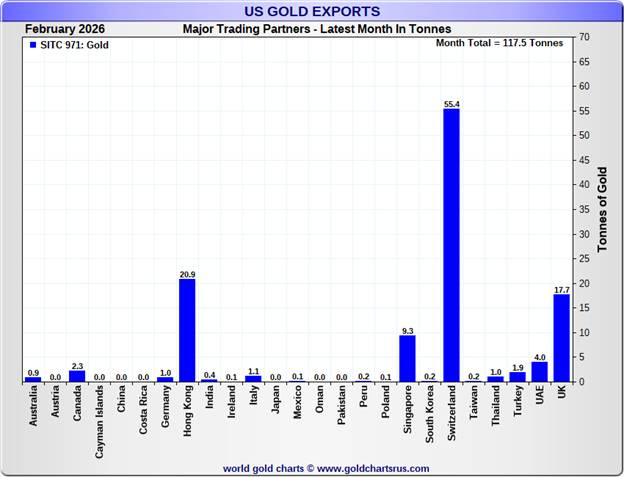
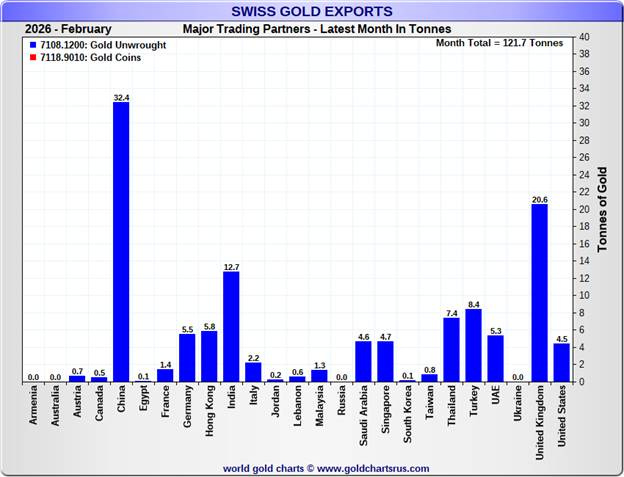
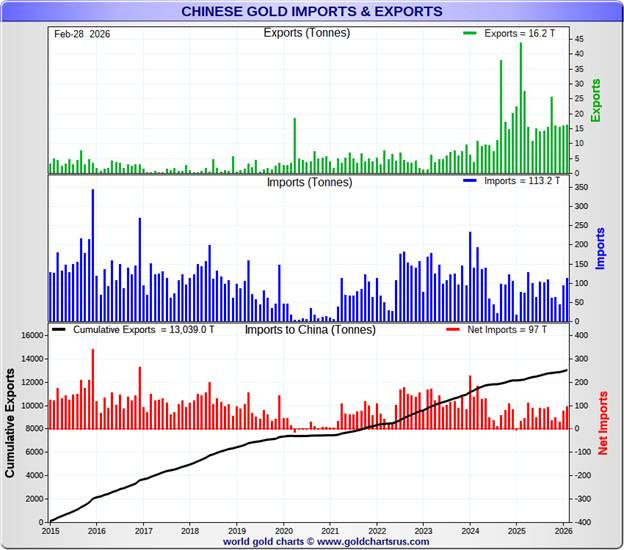
Swiss refineries receive US gold to recast into bars suitable for delivery to China.
Step 3: Pay the Tehran toll
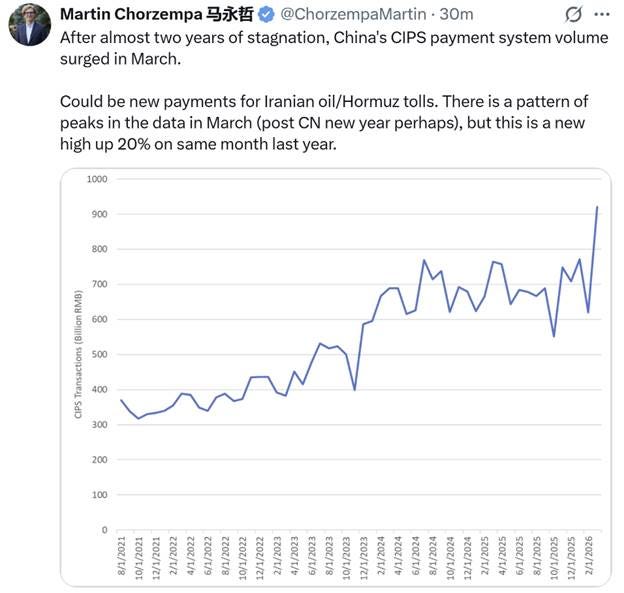
Buffalo Bill Bessent is deadly serious when he says, “It puts the dollars on its skin or it gets the sanctions again”. Because of US-imposed sanctions from almost fifteen years ago, Iran cannot use the SWIFT payment messaging network. To move yuan into the IRGC’s dirty paws requires the usage of the Chinese fiat CIPS messaging system. As you can see, volumes materially increased after the war began.
This series of charts shows a flow of dollar asset sales leading to gold purchases, which ultimately fund yuan payments to Tehran or other suppliers. It doesn’t matter that the dollar is still the dominant currency used in trade. Markets are forward-looking, and therefore the acceleration of the yuan’s use in global trade is more important than the low absolute usage amounts versus the dollar. By shunning dollar assets before the consensus accepts that a new currency regime exists, investors protect their portfolios. The Great British Pound technically was the global reserve currency until the Bretton Woods Agreement in 1944, but the dollar realistically supplanted the pound as the global reserve currency in the early 20th century as the American economy became the most productive globally. In 2026, America runs a trade deficit with the most productive economies: China, Japan, South Korea, Germany, Taiwan, etc. And most nations run a trade deficit with China. I say again more emphatically, what’s the fucking point of saving in dollars if you gotta pay those stone-aged towel heads yuan to receive your shit?
The Star-Spangled Blockade & The Empire Strikes Back
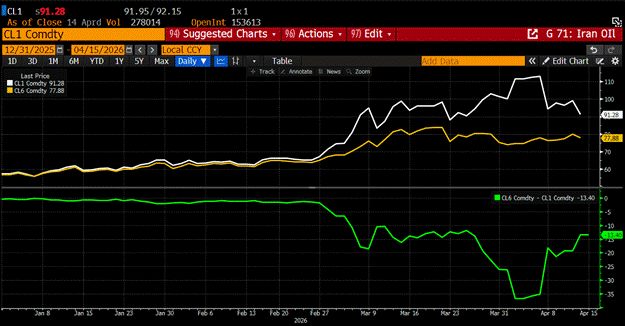
To answer the question of whether the strait is open or closed, look at the above or a version of this chart you can produce using your favorite charting service. On the top panel, the chart shows the May (CL1, white) versus October (CL6, gold) 2026 WTI futures prices. I used WTI because this benchmark is most relevant to American consumers of gasoline. Trump will only materially deescalate if gas prices remain high for voters going into the November midterm elections. The bottom panel is the spread between the two contracts (back minus front month); the curve is in backwardation. Because back-month oil prices haven’t risen as high as the front-month, the market believes enough oil flows through the strait will materially increase. If this happens, the spread will rise because front month prices collapse. But if the spread narrows because back month prices rise, then all hell will break loose in the global economy. Ignore all of the back and forth trolling between Trump and the IRGC, and focus on this chart.
Quantity versus Price of Money
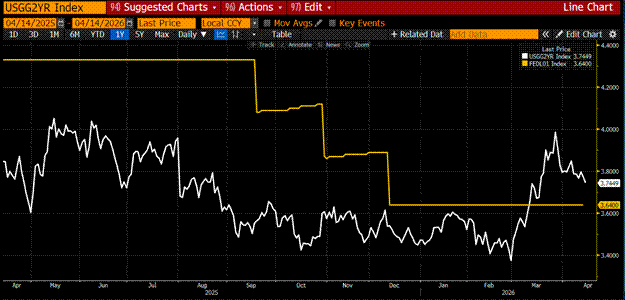
The two-year treasury bill yield (white) spiked much higher than the effective fed funds rate (gold) right after the start of the war. This showed the market believed the Fed would raise rates to counter rising energy inflation.
It’s time to pick a side. Do you believe the quantity or the price of money is more important when valuing Bitcoin? I believe the quantity of money determines the price of Bitcoin, not its price. Bitcoin has no cash flows, so the discount rate derived from central bank policy rates is irrelevant to valuing the magic internet money. But given Bitcoin’s fixed supply, its value in fiat terms depends on the total amount of fiat in existence.
It’s important to take a view on this because I believe we may enter a situation where the largest central banks, including even the Fed, might raise interest rates but simultaneously print money either directly or via the commercial banking system. As food and energy prices spike because of the war, politicians who can afford it will subsidize the prices of the primary input costs to their economies. Failure to do so could cause social unrest or famine. But so that inflation does not take hold across all goods and services, central banks must destroy demand by raising interest rates to curtail activity in credit-sensitive parts of the economy. Any entity that borrows money to spend on goods and services will spend less if the cost of credit rises.
If central banks stopped there, then my Bitcoin prediction would be straightforward. In an environment where people spend less on everything other than food and energy, Bitcoin prices fall. But every nation state whether friend or foe of Pax Americana, must increase defense spending and stockpile all important commodities. Do you want your country to be like Australia, which imports almost 100% of its refined hydrocarbons from China? China stopped all exports at the beginning of the war, and Australia possessed less than a month’s worth of reserves. They had to beg Singapore, and pay, I’m sure, an exorbitant amount, for jet fuel; otherwise, all those bogans would remain down under … indefinitely! I know some of you would rejoice in that outcome, especially Japanese skiers.
Building bombs, especially nuclear ones, to protect yourself from becoming a Trashcanistan at the hands of the Skinny Tie Prophet, and stockpiling commodities will require a dramatic increase in government borrowing. If domestic private investors cannot or will not buy these dog shit government bonds, the central bank and or the commercial banking system will print money and buy the bonds instead, which increases the supply of fiat.
This dynamic of rising central bank policy rates coupled with an expanding supply of money will create disparate risky asset price outcomes. Assets valued on discounted cash flows will slump as the price of money rises. Fixed or near-fixed supply assets like Bitcoin and gold will rally because central and commercial bank credit increases to fund government war and commodity stockpiling efforts.
Keep this dynamic in mind as you read my prognosis for Bitcoin under the various scenarios. You must form a view on whether the quantity or the price of money is more important. Otherwise, you won’t be able to make sense of what appears to be incongruous price action of different risky assets.
Back to Normal
Bitcoin might bounce a bit after the situation reverts to the pre-war status quo. However, the AI agentic deflation bomb still ticks below the surface. Until the Fed provides the liquidity needed to plug the black hole in banks’ balance sheets caused by consumer credit defaults, Bitcoin will not meaningfully rise. That’s not to say it couldn’t spike to $80,000 to $90,000, but for me putting new units of fiat at risk requires an all-clear from the Fed. Given I’m giga long already because I operate a long-only book, I’ll feel better looking at a higher net worth number on the screen but the risk reward is not there to back up the fucking truck and shift the portfolio to maximum risk levels.
I don’t know how long it will take for the banking system to crumble. But every week I read stories about this or that firm firing a material number of knowledge workers because AI agents are more productive than the average human, and other stories about rising consumer credit delinquencies.
Here is an anecdotal story. I recently caught up with a fellow entrepreneur who runs a successful crypto-gaming company. He is an OG. We began talking about how AI affects his business. A computer engineer by training, over the 2025 Christmas holidays, he sat down with the newest Claude model and tried to create something. He was so surprised by how quickly he could churn out shippable code that he brought his best engineers to a company offsite to discuss how AI will affect the business a few months later. He tasked them with creating an agentic workflow that allowed agents to code 24/7. They automated everything down to code-review so that when they woke up each morning, there was usable, tested code ready for the senior engineer to review. One person shipped his six-month roadmap in four days all by himself, supported by a team of AI agents. My friend decided after this offsite that his company had to change its workflow immediately. As a result, 50% of his staff will go the way of the dodo in the next few weeks. In the AI agentic age, the average engineer is superfluous, but using AI agents, the rock stars will get 10-100x more productive.
As the models obtain more specific domain expertise, all mediocre knowledge workers are at risk of losing their jobs. Unfortunately, even though there is unemployment insurance, the median US state maximum annualized payout for workers is ~$28,000, which pales compared to the median knowledge worker wage of $85,000 to $90,000 according to the BLS and St. Louis Fed. There is no other choice but to fall behind on consumer credit payments to banks. It’s game over for the fugazi fiat fractionalized banking system.
Bitcoin (gold) versus US Software SaaS ETF IGV US (white)
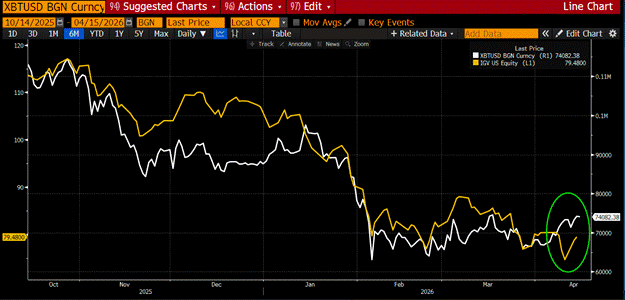
With all that being said, post the ceasefire, US SaaS software stocks resumed their down-only swoon, but Bitcoin held the line and rallied. This is a welcome break in the correlation, but for me, it is too early to declare that Bitcoin looked through the AI-related knowledge worker deflation and forecasts a big print.
Tehran Toll Booth
As nations sell down dollar assets to raise yuan and pay the toll, treasury and stock prices will fall. This might be a slow process because, as of right now, there are other payment options other than yuan. But because of the leverage embedded in the system, a small snowflake falling can cause a financial avalanche as selling begets more selling, volatility rises and markets freeze. Then the monetary mandarins must step in with printed money. The key index to watch in the MOVE Index, which measures US bond market volatility. When the index rises above 130, some form of money printing will occur.
As volatility rises, big US tech stock prices fall, and Bitcoin will have a hard time meaningfully rallying. As investors de-risk their portfolios because of higher volatility and lower prices, investors sell Bitcoin to meet margin calls. Only when things get bad enough will Bitcoin rise, as expectations of a bailout become the consensus.
Wait for Bessent and or whoever is the Fed chairperson to press the Brrrr button. The risk-reward for attempting to front-run this situation isn’t worth it. I hope that during any generalized TradMarket financial crash Bitcoin can hold $60,000. If Bitcoin tests and holds this level for the second time, then on balance I would favor adding risk.
The Star-Spangled Blockade & The Empire Strikes Back
As back-end oil futures prices rise quickly, catching up with spot or front month prices, the global economy will suffer. At some point, demand destruction will spank treasury and US stonk prices. Just like in the previous scenario, the initial reaction is for Bitcoin to fall. And once the over-leveraged Western financial system implodes, money printer go Brrrrr. If the blockade ultimately ends via a punitive bombing campaign of Iran followed by an Iranian destruction of all Persian Gulf energy production, this could lead to the destruction of the Iranian state. The rally in Bitcoin, inspired by money printing, might be short-lived because the destruction of the Iranian state materially raises the prospect of WW3.
Portfolio Construction
As an un-levered long-only investor, Maelstrom can let time and compound interest do their thang. The slight outperformance of Bitcoin over IGV US over the past few days is very encouraging. It will inspire me to reevaluate my bearishness on the price of Bitcoin as the AI knowledge work created financial deflation accelerates. The only asset I’m comfortable adding risk to at the current moment is gold and $HYPE (Hyperliquid’s governance token). HIP-4 will launch in a few weeks, and I predict this will take significant market share from Polymarket and Kalshi in the prediction market vertical.
Other than that, I shall pray daily to Lord Satoshi that they can infect the minds of our global class of political elites and convince them to drop acid, not bombs.
Want More? Follow the Author on Instagram, LinkedIn and X
Access the Korean language version here: Naver
Subscribe to see the latest Events: Calendar
[1] Trade data used from 2024 to 2025.
[2] IRGC - Iran Revolutionary Guard Corps
maybe i'm missing something but the message I'm getting is sell BTC, buy gold, and come back later.
Arthur is spot on here. When the geopolitical picture gets this chaotic and the AI deflation risk is ticking underneath, taking directional long-only bets feels like an absolute coin flip. The 'No Trade Zone' logic is completely sound for traditional portfolios.
However, the structural fragmentation caused by all this uncertainty is creating massive inefficiencies. We stopped trying to guess the direction of the market months ago. The only viable strategy for our liquid reserves in this environment has been market-neutral architecture. We moved our treasury into a Plugsic execution node specifically because their delta-neutral algorithms just harvest the volatility and basis spread regardless of whether the market melts up from money printing or crashes from a blockade. When the macro is un-investable, you don't pick a side, you automate the middle.